
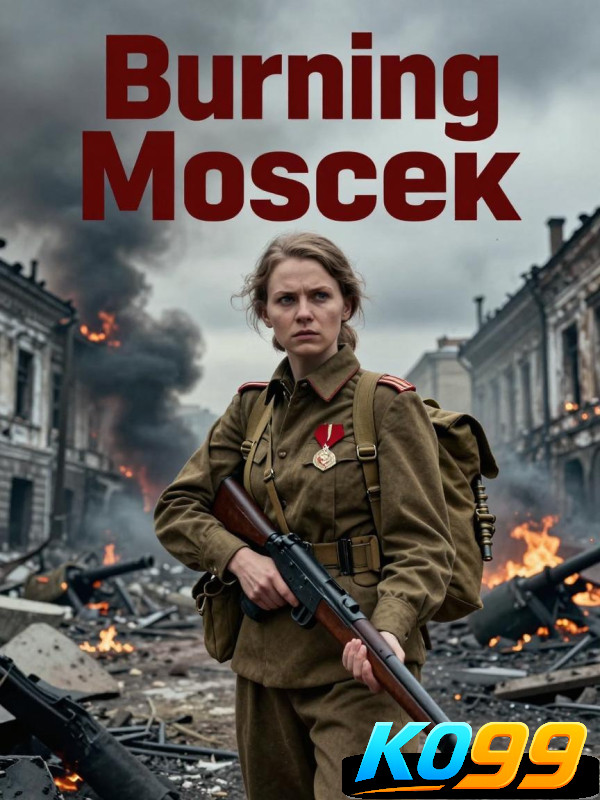
A typical time-travel novel chronicling the personal experiences of an ordinary female soldier during the Great Patriotic War.



Chapter 16: The Bronze Key By evening, the German forces we had repelled had still not launched a new offensive. The entire battlefield had fallen silent. I was in the first line of trenches with Pastukhov and Safchenko, observing the soldiers as they rushed to repair the bunkers and communication trenches. I was a complete layman when it came to the construction of defensive works, so seeing the soldiers working with such fervor, I refrained from giving uninformed orders or offering unsolicited opinions. As for Second Lieutenant Savchenko, before he was transferred from the anti-aircraft unit, he had little knowledge of defensive works either, so naturally he couldn’t offer any insightful guidance or suggestions—he remained silent just like me. Pastukhov, however, seemed to have participated in defensive battles at other sectors and had some authority to speak on the quality of defensive works. After inspecting these newly constructed positions, he immediately pointed out their shortcomings to me: “Comrade Lieutenant, look.” Pointing to a newly repaired machine-gun emplacement, he said, “From a military standpoint, this position is indefensible. The machine-gun post is positioned so that it can only fire in one direction. When the fighting breaks out, the soldier inside controlling the machine gun can, at best, only take cover from stray bullets or shrapnel. But those German devils usually bombard the area with artillery and bomb it with planes before their assault. If a firing position like this is hit by an artillery shell or struck directly by a bomb, it’ll wipe out everyone inside without a trace.” “Then what should we do?” Hearing his analysis, which made him sound quite knowledgeable about constructing defensive works, I quickly sought his advice. Although his rank was higher than mine, due to special circumstances, he was currently under my command. So when answering my question, he adopted the attitude of a subordinate addressing a superior and explained it to me very patiently: “When constructing defensive works in open terrain, we need to reinforce those temporary firing positions with steel plates. Only then can they hold out longer when targeted by artillery fire. In addition to building temporary firing positions, permanent ones are also essential…” Just as he was speaking at length, I suddenly heard Second Lieutenant Safichenko whisper from beside me, “Comrade Lieutenant, look—a commander is coming over.” I turned to look. In the distance, a burly soldier wearing a peaked cap and sporting a small mustache was striding purposefully toward us along the freshly dug trench, accompanied by several men. As he drew nearer, I recognized the colonel’s epaulets on his shoulders. I quickly jogged over, stood at attention before him, and saluted. “Comrade Colonel, Lieutenant Oshanina reporting. The troops are rushing to repair the fortifications. Please give your orders.” The colonel didn’t say a word; instead, he suddenly pulled me toward him and embraced me, exclaiming excitedly, “Well done! Lieutenant, you’ve really done a great job!” Although, according to Russian custom, the greater the force used during a handshake or embrace, the more it signifies friendship and warmth, his grip was simply too tight—so tight that I could barely breathe. He didn’t notice the pained expression on my face and continued, speaking as if to himself: “You are truly remarkable! As a veteran, I know how difficult it is to stand up amidst the whistling of bullets and the explosions of mortar shells; those first few seconds are decisive. Soldiers must either summon the courage to face death, driven by a sense of duty and the will of their commanders, or remain in the trenches…” His embrace pressed against the wound on my chest. The pain was so sharp I almost cried out, but I held it in—though tears still welled up uncontrollably. With tears streaming down my face, I thought of what Confucius once said: “Impulse is the devil.” It seems the old sage was absolutely right. I must have been possessed by the devil at that moment—otherwise, how could my little brain have gone haywire, causing me to leap out without a second thought and then lead the charge with such heroic fervor? If it weren’t for my good fortune and the copper key hanging from my chest that deflected the shrapnel, I’d be having afternoon tea with God right now. He let go of me and stood at the front of the line, calling me by my nickname in a warm tone. With a touch of emotion, he said, “Lieutenant Lida, do you know? Today, you didn’t just hold back the German devils here—you held them back elsewhere too. They didn’t advance a single step. According to aerial reconnaissance, our navy’s long-range artillery also wiped out a massive tank and armored force that was attempting to bypass the high ground once again…” His voice sounded familiar; it must have been the man who spoke with me on the phone earlier that day, though I still didn’t know who he really was. Although he spoke in a matter-of-fact tone, from what I knew of history, I was aware that explosives had been planted in many important facilities and buildings in the city behind us. If the German forces breached the defensive line, those places would be reduced to rubble. “Comrade Division Commander.” A signalman hurried over, saluted the colonel, and reported loudly, “Report, Comrade Division Commander! Major General Fei Jiuning, Commander of the Army Group, orders you to return immediately. He says there is an important mission.” From the signalman’s words, I realized this was Colonel Novikov, the commander of the 21st Division. By the time I finished all my work and rushed back to rest, it was already 11:00 p. m. I walked into the women’s barracks and saw that it had been tidied up spotlessly. Rows of bunk beds stood in orderly formation; moonlight swept across the young faces as they breathed evenly, their expressions sweet with the bliss of deep sleep, occasionally punctuated by a few indistinct mutterings. My bunk was the lower one on a wooden bed near the door. When I chose this spot, I justified it by saying it was close to the main entrance, making it convenient for me to go out and command operations at any time. In reality, it was because I was quite afraid of dying; if we came under German artillery fire or an air raid, being near the door would make escape the easiest. “Lida. ” I walked over to the bed, bent down to climb in, when suddenly I heard someone above me softly calling my name. I looked up and saw it was Lena, the soldier sleeping in the top bunk. I stood up straight, leaned close to her, and asked softly, “Lena, it’s so late—why aren’t you asleep yet?” “I can’t sleep. Can I talk to you?” “Sure, sure, of course, Lena-chka.” Although I was a little surprised, I agreed. After all, she didn’t know my true identity, so I wasn’t worried that her questions might give me away. I lay down fully clothed and pulled the blanket over me. She was wearing only a thin silk nightgown that barely covered her private parts. She climbed down from the top bunk and quickly crawled into my bed. She lay in my arms without saying a word, but one of her hands began to roam over my chest. Goosebumps instantly broke out all over me. I wondered if she was a lesbian—otherwise, why would she start groping me the moment she got in bed? Just as I was considering whether to grab her hand and stop her from groping me, she stopped. Reaching through my clothes, she grabbed the brass key hanging from my chest and asked curiously, “Lida, what kind of key is that hanging from your chest?” I reached up to touch the long-warped brass key, silently thanking my lucky stars that having it hanging there had saved my life today. I gathered my thoughts, listening to myself as if from the outside: “It’s the key to my home—a gift from my husband.” The word “husband” made me feel exceptionally awkward; my face flushed crimson with embarrassment. Fortunately, it was dark, and Lena didn’t notice my unusual expression. “Is your husband in the army too?” Lena asked curiously in a soft voice. I stroked the key against my chest, and the fragmented memories of its origin finally came together into a complete story. I began to tell Lena the story of Lida and Oshanin, though I spoke in the first person: “My husband’s name is Oshanin; he’s a captain at a border outpost… He had a military dog that never left his side. Although I’m terribly afraid of dogs, whenever we went on dates, that dog would follow us, yet I wasn’t afraid at all… After we got married, we had our own home, and he personally hung this key around my neck... When the war broke out, he rushed back to the front lines. Just before he left, I hung this key around his neck again and told him to make sure he came back safely... …Little did I know that one morning a few days later, I would find his military dog lying outside our front door, barely breathing, with that gleaming brass key still hanging around its neck. The moment I took the key off its neck, it closed its eyes. Ever since then, I’ve kept this key hanging around my own neck…” I told the story in a soft voice, but the hand wrapped around Lena’s waist habitually roamed over her body—from her pert buttocks to her full breasts, running up and down her entire frame. At the same time, I couldn’t help but marvel inwardly: Russian girls really are something else. Not only are they beautiful, with fair, smooth skin, but their figures are top-notch too—they just feel so good to the touch. it’s just a shame their “shelf life” is a bit short—by middle age, they turn into Auntie Katya with a beer belly. I groped Lena all over, and not only did she show no sign of displeasure, she seemed to be quite enjoying it. Before long, she actually fell asleep in my arms.