
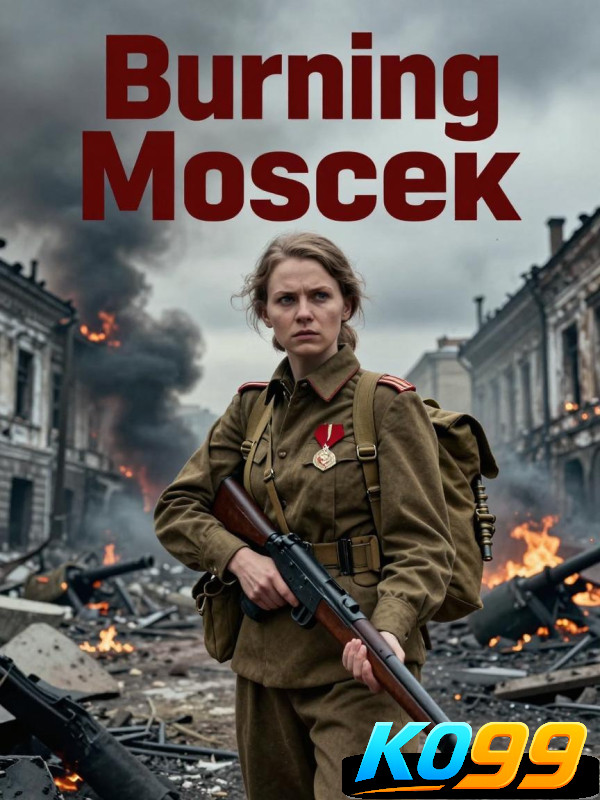
A typical time-travel novel chronicling the personal experiences of an ordinary female soldier during the Great Patriotic War.



A typical time-travel novel chronicling the personal experiences of an ordinary female soldier during the Great Patriotic War.
Prologue When my friend Andrei walked into my shop, I was on the phone with a friend back home, discussing the recent forest fires on the outskirts of Moscow. She had heard about the fires in Moscow from reports back home and mistakenly believed the entire city was engulfed in flames. Worried about my safety, she had called specifically from China to check on me. I pointed to the empty chair beside me, gesturing for him to sit down and wait until I finished my call. At the same time, I continued teasing my friend back home: “... Don’t you think the person who wrote the song ‘0. 5 Miles’ might have time-traveled here once, witnessed Moscow surrounded by forest fires on the outskirts, and that’s why they penned those classic lyrics: ‘Let red burn Moscow, let memory smear Leningrad’...” Andrei is a regular at my shop. Seeing that I was on the phone, he didn’t say a word, but just smiled and nodded at me, then casually tossed a white cardboard box—wrapped tightly in clear tape—onto my desk. Without sitting down, he turned and walked over to the water cooler, grabbed a paper cup, and started drinking glass after glass of water. I stared at the box in front of me, muttering to myself as I spoke on the phone: What on earth is in this box Andrei gave me? Because of this, I found myself distracted while chatting with my friend on the phone, and several times I didn’t answer his questions directly. My friend sensed something was off and asked with concern if I had something urgent to attend to. Eager to figure out what was inside André’s box, I hastily agreed: “Right, right, I’ve got something that’s come up. I’ll call you back another time.” As soon as the other person said goodbye, I hung up immediately. Andrei walked over with a glass of water and sat down across from me. As he drank, he asked me in broken Chinese, “Did you finish your call? What were you talking about? You sounded so excited.” “My friend saw the news about the ongoing fires in Moscow. He thought the whole city was on fire and was worried about my safety, so he called to check on me.” Andrei drained the cup in one gulp, crumpled the paper cup, and tossed it into the nearby trash can. Then, with a deadpan expression, he said, “You should tell your friend that the only thing separating us from a piece of grilled meat right now is the lack of a sprinkle of cumin.” Hearing Andrei say this, I was taken aback at first, then burst out laughing. I hadn’t expected him to be so humorous, and the fact that he delivered the entire joke in Chinese with a slightly odd accent only added to the comedic effect. After we finished laughing, I picked up the cardboard box Andrei had just tossed on the table, held it in my hand, and felt that it wasn’t very heavy. Smiling, I asked him, “ “Andrei, is this the fan you bought for me? Why is it so light?” “A fan?” As soon as he heard the word, the expression on Andrei’s face froze. He scratched the back of his head and said, somewhat sheepishly, “I’m sorry, Tang. I let you down—I wasn’t able to get you a fan. ” Perhaps fearing I would blame him, he immediately began shifting the blame: “It’s not that I didn’t try my best, but this year’s weather has been so hot, and with the forest fires in the outskirts, electric fans—which nobody used to buy—have become hot commodities. When I bought one for someone else early last month, it cost over 300 rubles. Now, less than a month later, the price has risen to over 3,000 rubles—a tenfold increase. Even at that price, there’s no market for them. I’ve scoured every supermarket and department store in the city lately, but I haven’t seen a single electric fan for sale.” The weather in Moscow has been very unusual this year. It’s been exceptionally hot since summer began in June, and so far, it hasn’t rained for nearly two months. The prolonged heatwave and drought have sparked massive forest fires in the outskirts. Moscow, often called the “City in the Forest,” is now surrounded by burning forests. The city is shrouded in smoke every day, and its residents have effectively become pieces of meat roasting on a grill, smoked and scorched by the flames. Under these circumstances, air conditioners and electric fans—which were usually ignored in previous years—have become hot commodities overnight. Since the shops on our street all sell winter leatherwear, customers are unlikely to come in to try on clothes when it’s too hot. Faced with the dismal business caused by the sweltering heat—which had left their stores virtually deserted—the shop owners banded together to approach the Jewish manager of the market, hoping he would allow them to install air conditioners on their own. However, the market owner was concerned that if air conditioners were installed on a large scale, the existing transformer station would be unable to handle such a high load, and frequent circuit breakers tripping would lead to widespread power outages in the market. Therefore, he strictly prohibited the installation of air conditioners in any of the market’s shops. Given this strict regulation imposed by the market, the merchants had no choice but to settle for the next best option: purchasing electric fans. But since the fans at the market’s electronics vendors had long since sold out, merchants in urgent need of fans resorted to all sorts of creative solutions: some asked people to buy them at other markets; others asked people to bring them from back home; and some even asked friends from other regions to buy them locally and bring them along when they came to Moscow. Near the apartment building where I live, there are several large shopping malls, and I had previously seen shops there selling fans. But when I went to buy one, I found they had been out of stock for who knows how long. Just as I was worrying about it, Andrei, who often drops by my shop, heard about it. He patted his chest and assured me that since he knew the area well and was always driving around the city, getting a fan was a sure thing. Precisely because I understood the current reality, I didn’t hold it against him at all after hearing what he said. To spare him any guilt, I quickly changed the subject. I held the cardboard box in my hand up higher and asked curiously, “Andrei, what’s inside this box?” Andrei didn’t answer right away. Instead, he said mysteriously, “Take a guess.” “I can’t guess.” This box, about a foot square, could hold countless things. I had no time to play guessing games with him, so I said bluntly, “I can’t guess. Just tell me what it is.” Seeing that I refused to guess what was inside, a look of slight disappointment flashed across André’s face. Noticing my impassive expression, he could only say helplessly, “Alright, since you don’t want to guess, I’ll just show you what it is.” With that, he picked up the paper cutter I’d left in the pencil holder and sliced through the tape wrapped around the box. As the box opened, its contents were revealed—something I would never have guessed no matter how hard I racked my brain. It was a steel helmet, a German-style steel helmet. To be precise, it was a World War II-era German military helmet, now rust-stained and bearing an irregular bullet hole on the right side. I stared in utter amazement as André took the helmet out of the box and held it in his hands, examining it from every angle. Seeing the look of astonishment on my face, he asked smugly, “You didn’t expect there to be a helmet in the box, did you?” “I didn’t. I really didn’t.” I shook my head vigorously, indicating I hadn’t the faintest idea what was inside the box, then asked curiously, “Andrei, what are you going to do with a beat-up German helmet?” Andrei carefully placed the helmet back into the box and re-sealed it with tape. As he wrapped the tape around it, he explained to me, “Next month, there’s a war game organized by a military enthusiast club in the Smolensk region. It’s meant to recreate the Battle of Smolensk between the Soviet and German forces during the Great Patriotic War. I’m playing on the German side, so naturally I need to prepare German equipment.” Thinking of that rusty steel helmet, I couldn’t help but frown. “Andrei, you could easily buy a new one. Why did you have to get such a beat-up one?” Hearing this, Andrei shot me a disdainful glance before lecturing me: “Historical accuracy—do you even know what that means? It means that when reenacting those battles, both sides must use the actual weapons and equipment from that era. Not just the uniforms, helmets, and rifles—which are all antiques—but even the tanks and artillery are from World War II.” Don’t let the battered look of this helmet fool you. When I bought it at the flea market today, the vendor told me the original owner was shot dead by his own grandfather. If his family hadn’t been desperate for cash, he never would have parted with something so meaningful. He asked for 10,000 rubles, but luckily I’m good at haggling. After some back-and-forth, I finally got it for 6,000.” ” As Andrei said this, his face was beaming with pride, as if he’d scored a real bargain. I knew full well that he’d definitely been taken in by the flea market vendor, so I got up, walked over to the water dispenser, poured two glasses of water, handed him one, and then gently reminded him, “Andrei, can a beat-up helmet like that really be considered a family heirloom? You weren’t just being hoodwinked by the vendor, were you?” “Huyou? What’s huyou?” Although Andrei’s Chinese was quite good, he didn’t understand this term, which clearly had a Northeastern Chinese flavor. “Huyou means repeatedly praising an item to you, telling you how wonderful it is, and then selling it to you at a high price.” After hearing my explanation, Andrei picked up the cup and took a sip of water. Then he sat there with a grave expression, saying nothing, as if pondering what I had just told him. Seeing his expression, I couldn’t help but worry inwardly, wondering if he’d realized he’d been duped and was about to run back to the flea market to demand a refund. After staring into space for a moment, Andrei didn’t mention the helmet again. He took another sip of water, pointed at the newspaper spread out on the table, and asked casually, “What’s in the news in your paper? “I see the headline still mentions Moscow—why is that?” Although his Chinese was fluent, he didn’t recognize many Chinese characters, just as my spoken Russian was passable but I couldn’t read Russian newspapers. Sometimes, we’d even read each other’s national newspapers. I picked up the newspaper and said to him, “Even if I don’t tell you, you can probably guess what’s in the news—it’s mostly about the forest fires in Moscow. Let me read you a passage.” After saying that, I picked up the glass of water on the table, took a sip, and began to read aloud: “…Russia has recently experienced the most severe siege Moscow has faced since repelling German forces in 1942—a siege of fire and thick smoke. On August 4, smoke shrouded Moscow, creating an extremely grim scene. As far as the eye could see, this city in the forest looked as if it had just been bombed. In some places, visibility was so low that people outdoors could barely make out their own arms... Doctors advised people to stay indoors, keep doors and windows tightly shut, but being cooked by the heat wave at home was better than going outside to breathe the toxic smoke...” Hearing this, he suddenly raised his hand to interrupt me: “I heard a joke last night. Let me tell it to you.” “Go ahead, I’m all ears!” I said, setting down the newspaper I was holding. “There was a couple who had a fight and were threatening to break up. Later, they agreed to walk away from each other, back-to-back, for a hundred steps, then turn around. If they could see each other, they wouldn’t break up; otherwise, if they couldn’t see each other, they’d break up. After saying this, the two set off. They took just two steps with their backs to each other before both couldn’t help but turn around. As a result, they broke up.” Perhaps the joke was just too dry, but after hearing it, I was still completely baffled. I asked in confusion, “I don’t understand—why did they turn around after only two steps, and then break up?” Seeing that he hadn’t struck a chord with me, a look of disappointment flashed across André’s face. He put on a serious expression and explained, “Relationship experts advise couples in the throes of passion not to play this kind of love game on a foggy day, or it will bring you a lifetime of regret.” After saying this, he burst out laughing. With André’s explanation, I immediately got it. When visibility is so poor you can barely see your own arm, if two people take two steps in opposite directions and can actually see each other, that would be nothing short of a miracle. Thinking of this, I couldn’t help but chuckle along with him. After we finished laughing, he suddenly asked curiously, “By the way, when I walked in, I thought I heard you telling a friend on the phone something about ‘Moscow in flames, Leningrad in blood.’ What was that all about?” Hearing this oddball question from him—the curious one—I really didn’t know whether to laugh or cry. It seems his Chinese isn’t all that great either; he even misheard such a simple conversation. But since he brought it up, I decided to patiently explain it to him: “Andrei, you heard wrong. I wasn’t saying anything about ‘Moscow in flames, Leningrad in blood,’ but rather two other lines from the song: ‘ ‘Let red burn Moscow, let memory paint Leningrad.’ My friend is a ‘corn,’ so that’s why I brought up the lyrics to this song when chatting with her.” “Corn? What’s a corn?” Andrei asked curiously. “Corn, you know.” Seeing his blank expression, I—always eager to teach—took the opportunity to educate him on some pop culture: “ She and I both like the same singer, and that singer’s songs are really popular, so she has a huge fanbase. These fans are all collectively called ‘corn.’ ” “Fans—I get that,” Andrei continued. “But I want to know what ‘corn’ actually is. Do we have that kind of plant in our country? And what’s it called in Russian?” Hearing him say that, I realized I’d misunderstood. I’d thought he wanted to know why fans were called “corn,” but it turned out he just wanted to know what “corn” actually was. So, I quickly pronounced the word in Russian: “Guguruzi!” “What? What did you say?” Maybe I spoke too fast, or my pronunciation wasn’t clear, because Andrei didn’t catch it: “ “Say that again. How do you pronounce it?” To make sure he heard me clearly—and to check if my pronunciation was correct—I repeated it: “Guguruzha!” When I saw his expression hadn’t changed, I went for it two more times: “Guguruzha! Guguruzha!!” No sooner had I finished than an old woman’s voice suddenly called out from the doorway: “Hey, are you the ones looking to buy corn?” I looked in the direction of the voice and saw that standing at the shop entrance was the same old woman who’d been pushing a cart selling boiled corn on the street. She must have been passing by just as I shouted the word “corn,” so she stopped to ask. When Andre and I heard the old lady’s question, we were taken aback for a moment, then both burst out laughing. Seeing that she was a bit flustered by our laughter, I walked up to her and asked, “How much are the corn on the cob?” “Fifty rubles each,” the old lady replied with a smile. Andre walked over and looked at the steaming corn in the pot on the special cart behind the old lady, saying, “ “So this thing translates to ‘corn’ in Chinese. I’ve finally learned a new word.” After Andrei finished speaking, I started haggling with the old lady: “Fifty is too expensive. Didn’t you sell them for thirty rubles each last year? How about this—will you sell them to me for forty rubles?” Upon hearing this, the old lady shook her head vigorously: “No, no, fifty rubles each. I can’t go any lower.” I knew full well that you can’t haggle over items with a fixed price like this; I was just killing time by bantering with the old lady. I pulled a hundred-ruble note from my T-shirt pocket and handed it to her, feigning magnanimity: “Since you won’t budge on the price, never mind. Here’s a hundred rubles—pick out two good ones for me.” ” I added a special reminder at the end, “Remember, sprinkle plenty of salt on the corn—it doesn’t taste good with too little.” As Andrei and I each held a salt-sprinkled boiled corn cob and munched away happily, Andrei suddenly stopped and asked me, “Hey, Tang, are you going straight home after we close today?” “Mm-hmm, of course.” I continued munching on my corn while pointing at the occasional wisp of white smoke drifting past the door: “Look, there’s smoke everywhere out there. It’s so thick you can’t even keep your eyes open. Staying out there would be asking for trouble. It’s safer to just stay home.” “How about going for a swim in the Moscow River and getting some fresh air while we’re at it?” Swimming? When I heard Andrei’s suggestion, I was actually a little tempted, but seeing the smoke drifting past the door, I quickly dismissed the thought. In such terrible conditions, going for a swim in the river really wouldn’t be much fun. “Never mind, I don’t think I’ll go after all.” Having made up my mind, I started looking for excuses to get out of it. “Look at all that smoke out there. There’s burnt ash floating everywhere in the air. I bet there’s a thick layer of soot floating on the river’s surface.” “No, no. I was just there yesterday, and the river was still pretty clear.” My first excuse was brushed aside with a casual wave of his hand. “There’s more.” I kept searching for reasons not to go: “Besides, even if I wanted to go, I don’t have swim trunks, so I can’t get in the water anyway.” “So that’s what you’re worried about.” After hearing my second flimsy excuse, André said dismissively, “No problem. On my way here, I passed by the swimwear section and just bought a dozen. I’ll just give you two pairs.” Seeing how well-prepared he was, I really couldn’t refuse without a solid excuse. Just as I was racking my brain for a way to turn him down, he leaned close to my ear and whispered, “Across the river from where I usually go swimming, there’s a nudist camp. Every day, there are plenty of pretty girls over there sunbathing or swimming.” “Nudist beach babes.” Hearing him say that, my lecherous nature came out in full force—I almost drooled all over the corn I was holding. I quickly grabbed a piece of paper to wipe my mouth, tossed the half-eaten corn into the trash can, sat up straight, and put on a serious face. “ “Alright, since you’ve invited me to go swimming so many times, I can’t just turn down your kindness—I wouldn’t want to hurt your feelings. Don’t you agree?” Before he could answer, I added to myself, “Anyway, there’s not much business today. We can just head out right now; I’ll close up shop. Ugh! The air in here is just too stuffy—I really need to go down to the river to breathe some fresh air.” Since the closing procedure was rather tedious, I asked André where his private car was parked and told him to wait for me in the parking lot while I locked up. After locking the door, getting the security guard to sign off, and activating the store’s alarm, I hurried straight to the parking lot to find Andrei. His nearly brand-new black Mercedes stood out like a sore thumb among the colorful Ladas, Zhigulis, and other old-fashioned cars; I spotted it from a good distance away. I walked quickly over to the car, only to find the doors locked and no sign of Andrei. Seeing this, my first thought was, “Could I have gotten the wrong car?” To be sure, I walked around to the front and checked the license plate. No mistake—it was definitely Andrei’s plate number. I pulled out my phone, just as I was about to call him to ask where he’d gone. Just as I was dialing, I suddenly heard him calling my name. I quickly looked up and scanned the area, but didn’t see anyone. Then I heard him shout in Russian, “Look behind you—I’m right behind you!” I turned my head and saw him crouching next to a medium-sized truck. I hurried over and asked him in surprise, “Why aren’t you in your car? What are you doing out here?” “Oh, don’t even get me started!” he said with a grimace. “The moment I got in the car, it felt like a sauna in there—I almost got heatstroke. So I turned on the AC and came to hide in this shady spot.” With that, he motioned to me, “Don’t just stand there like an idiot. Come sit in the shade for a bit. Once the temperature in the car cools down, we’ll go back inside.” After five or six minutes, he suddenly stood up and said, “It should be cool enough by now.” With that, he walked briskly over to the car, opened the door, and climbed inside. A moment later, the passenger-side window rolled down, and he leaned out to call to me, “Get in!” As we drove, Andrei mentioned that the swimming spot wasn’t far from the market—only about ten kilometers away—and we’d be there in half an hour at most. Once we left the market, I noticed the smog had thickened; visibility was no more than twenty meters. Because of this, traffic was incredibly congested. Yet, after more than an hour, our car was still inching along in the long line of traffic. Seeing my anxious expression, André reassured me: “Don’t worry. In about two kilometers, there’s a parking lot up ahead. We’ll park there and walk to the river.” Hearing this, I felt slightly more at ease. On such a hot day, sitting in the car under the blazing sun—even with the air conditioning on—still carried the risk of heatstroke. If we had to drive for several more hours, I’d rather get out and walk—at least there were plenty of trees along the roadside to provide some shade. Just as my mind was wandering, I caught a glimpse of a tank on the left side of the road. It was clearly an extremely old model, hugging the roadside and moving in the same direction as our car. I was just about to call out to Andrei to look at this suddenly appearing tank, but it was moving so fast that in the blink of an eye, it vanished into the thick haze. Seeing this, I couldn’t help but shiver. I reached out and tapped Andrei on the shoulder, pointing in the direction the tank had disappeared, and asked nervously, “Andrei, did you see that tank by the roadside?” “A tank?” Andrei looked in the direction I was pointing, then said dismissively, “Oh, you must be talking about the tank sculpture by the roadside up ahead. That’s a decorated tank that saw action in the Great Patriotic War. But the fog is too thick right now and visibility is low; we can’t see it from where we are.” “No, it wasn’t a sculpture.” I waved my hands frantically in protest. “It was a real tank. I saw it clearly—it must have been a T-34. It was driving along the side of the road just a moment ago, moving pretty fast. In the blink of an eye, it vanished into the thick fog.” After hearing this, Andrei turned his head and gave me a once-over, chuckling as he said, “Tang, you haven’t gotten heatstroke, have you? Mistaking a truck for a tank.” Hearing him say that, I didn’t feel like explaining further. I could only mutter to myself that maybe I really had been confused by the heat, so it was entirely possible that I’d been seeing things for a moment. Our car drove another two or three hundred meters. Andrei cleared his throat, turned to look at me, and pointed out the window, saying, “ “Take a look at the left side of the road now. Isn’t this the sculpture you saw when you had that hallucination just now?” I looked in the direction he was pointing. Parked in the roadside greenbelt was a tank, its rear half deeply sunk into the ground, the front half of the hull raised high, and its long barrel pointing straight up at the sky. Judging by the condition of the green paint on the hull, it must have been recently maintained. We drove on for another half hour or so. After letting out a long sigh, Andrei turned to me and said, “Thank God, we’re finally here. Once I pull into the parking lot, we’ll walk down to the river.” After pulling a duffel bag out of the trunk, Andrei locked the car. He led me through a dense grove of trees to the swimming area by the river. Standing at the edge of the woods, I looked out at the crowd on the grassy field—people standing, sitting, or lying everywhere—and couldn’t help but ask Andrei curiously, “Why is there a grassy field here by the river instead of a sandy beach?” “There is a sandy beach,” Andrei said, pointing across the river. “The nudist camp is located over there—that’s the sandy beach. But this side has always just been grass.” I looked across the river and saw, just as he’d said, a stretch of golden sand on the opposite bank of the wide Moscow River. Because of the thick haze over the river, I could only vaguely make out that the opposite beach was also packed with people; as for whether they were wearing swimsuits, I really couldn’t tell. I looked around and noticed that apart from a few stalls selling goods, there were no other structures in sight, so I couldn’t help but ask Andrei again, “Hey, buddy, where are we supposed to change?” Andrei casually pointed to the side and said, somewhat impatiently, “Just change right here. This grove of trees is a natural changing room.” With that, he tossed a pair of swim trunks my way and began stripping off his own clothes with nimble hands and feet, constantly urging me to hurry up. Although there were plenty of trees around me, this was still a public place, and the thought of changing in full view of everyone made me feel a bit self-conscious. Just as I was hesitating, I happened to catch a glimpse of a few young girls nearby who were undressing as if no one else were there. After slipping into their bikinis, they ran out of the woods, chatting and laughing. Seeing how open and natural those young women were, could I really be any less confident than they were? So I took off my clothes and put on my swim trunks. Once I was in my swim trunks, André took the clothes I’d taken off and casually stuffed them into the duffel bag he was carrying. Instead of rushing into the water, he led me through the crowd. When we reached a less crowded area, he pulled two large beach towels out of his bag, spread them on the grass, and motioned for me to lie down and sunbathe first. Seeing this, I asked curiously, “Andrei, why aren’t we going in for a swim yet?” Sitting on the towels, he applied sunscreen and replied calmly, “No rush, no rush. Look at the river right now—the water’s covered in ash. We’ll go in once it’s cleared up.” I glanced at the river, and sure enough, a layer of gray ash was floating on the surface. Almost everyone was staying on the shore; there were hardly any swimmers in the water. Seeing this, I couldn’t help but groan inwardly—water this dirty? Even if you asked me to get in, I wouldn’t. Since I didn’t know how long it would take for the river to clear up again, I lay down on the towel spread out on the grass, closed my eyes to rest, and before long, I drifted off to sleep without realizing it. In my sleep, it felt as though someone was shaking my shoulders repeatedly, and I heard a familiar voice: “Tang, Tang, wake up, wake up quickly.” I opened my eyes dazedly and saw Andrei crouching beside me, calling out to me. I sat up abruptly and asked, “Can we go in now?” “Yes, yes, yes, the water’s clear now. You can go in.” I hadn’t swum in years, so to be on the safe side, for the first half-hour after getting in, I only dared to swim back and forth in the shallow water near the shore. André knew I wasn’t much of a swimmer and was worried I might get into trouble, so he didn’t dare stray far—he was probably ready to act as my personal lifeguard. As we swam, he suddenly called out to me: “Hey, Tang, look! There are two pretty young girls right in the middle—they swam over from the other side. Let’s go say hi to them.” Without waiting for me, he sped up and swam toward the center of the river. Watching his receding figure, I muttered to myself: “What a womanizer—prioritizing women over friends.” ” After cursing him, I followed him and swam forward. Although I was swimming as hard as I could, having not swum for over a decade, I was no match for someone like Andre who swims regularly. He had already reached the two girls and was laughing and chatting loudly with them. As for me, I was still floundering desperately twenty meters away. Just as I was only seven or eight meters away from the three of them, I suddenly heard a commotion on the opposite bank. It turned out that the ruffians who had been playing on the beach and in the woods were screaming like madmen, diving into the river in droves and swimming toward us with their arms flailing. My feet kicked up water as I stood still, staring in astonishment at the crowd drawing closer, unsure of what exactly was happening. Just then, Andrei, who had been joking and laughing with the two girls, also paused for a moment, looking at a loss. Then he and the girls began swimming toward me, shouting something loudly as they swam. With the din of voices, I couldn’t make out a word of what he was shouting, so I remained where I was. It wasn’t until he swam close to me that I realized he was shouting, “Tang, swim back quickly! The woods over there are on fire—get back to shore fast!” By then, wisp after wisp of choking smoke was drifting toward me on the wind, giving me quite a scare. I quickly turned around and swam toward the shore with all my might. Although I was swimming faster than before, more and more people were passing me from behind, frantically making their way to the shore. When my feet touched the shore, I couldn’t help but glance back over my shoulder—and was instantly terrified out of my wits. I saw raging flames sweeping toward us from the direction of the fire, engulfing the sky. The trees along the riverbank were damp, and once they caught fire, the smoke became even more acrid and choking. Although the fire was still far away, separated by the sandy beach and the river’s hundred-meter-wide surface, that suffocating stench and the rolling heat wave were already bearing down on me. The people who had been sunbathing on the grassy shore had long since fled, and even Andrei, who had reached the shore before me, was nowhere to be seen. The crowd that had just fled from the opposite bank had turned into a headless swarm of flies, unsure of where to run. The raging flames and choking smoke only heightened everyone’s panic. Like them, I had lost all reason and thought; all that remained was the instinct to run, heading wherever I saw a crowd of people. Just as I was about to run into the woods where people had been changing, someone slammed into me from behind. The force of the impact sent me flying forward involuntarily, and my head struck a large tree with a direct blow. As I felt excruciating pain, my vision went black, and I immediately passed out.