
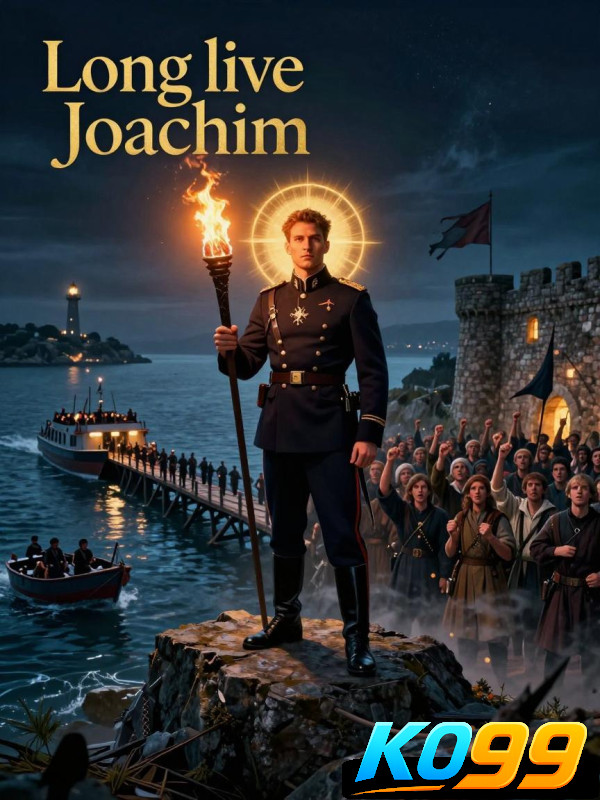
He traveled back in time to Germany over a century ago, where he carved out a place for himself through wisdom, insight, diligence, and perseverance. He pioneered amphibious landing tactics and conquered small European island nations; with extraordinary courage and determination, he climbed step by step to the pinnacle of his life. Crowned with the sacred aura of a savior, he listened to the cheers of the masses: “Long live Joachim!”



Chapter 174: Shining Again (First) Aha! Sinked! We sank that American cruiser! You did a great job! Your Majesty Joachim Seeing the violent explosion and rapid sinking of the Lexington, Rear Admiral von Heinke, commander of the escort fleet of Frederick Caesar, cheered without hesitation in front of a group of officers. The excitement of the previous attack by enemy submarines and cruisers, which caused the enemy ship to sink and be injured, was all released at this moment. Compared to the flamboyant Major General Heineken, Colonel Farrell's calm and composed demeanor makes one feel that he is more suited to serve as a commander of the fleet. At this moment of great joy and excitement among the crowd, the colonel still did not forget his duty and remained cautious in monitoring the changes in the battle situation. Shao Qing, he reminded Heinke, "General, our 'Langford' has already deployed four Osprey bombers The German Rear Admiral followed the sound from the air and indeed saw four biplanes carrying aerial bombs, with striking clover logos painted under their wings. In this era of the rise of monoplane aircraft, a large number of different types of biplane aircraft still dominate the active ranks of various countries' aviation forces. The IK-30T "Osprey", born in the 1920s, is one of them. Its payload flight speed is like a stupid goose walking on land, but its structure is sturdy, low-cost, easy to operate, and capable of low altitude bombing and dive bombing. Moreover, its bombing hit has been greatly improved compared to early carrier based aircraft. More importantly, because of its biplane structure, its takeoff distance is less than two-thirds of the German Ju-17T, making it very suitable for use on auxiliary aircraft carriers such as the "Langford". When the war broke out, Germany and Ireland had a total of 16 aircraft carriers, three more than the United States and Britain. Among these 16 aircraft carriers, the true main carriers are 3 Zeppelin class and 7 Allied class, with the remaining 6 being training carriers and half auxiliary carriers. When Germany declared war on Britain, the "Langford" was still lying on the slipway of the Royal Limerick Shipyard. If it had not received the modification order, it would have ultimately become a standard cargo ship with a self weight of 6000 tons and a cargo capacity of 5000 tons. The idea of transitioning from standard cargo ships to auxiliary aircraft carriers did not come overnight. In the early 1930s, the outbreak of a major war seemed inevitable. In order to cope with the possible losses suffered by their own merchant ships, Germany and Ireland jointly designed several standard cargo ships with lower construction costs and less labor consumption, suitable for large-scale construction during wartime. By the summer of 1932, the first standard cargo ship had been completed and all performance had reached the expected level. Since then, Germany began building standard cargo ships at a rate of 36 per year, and Ireland at a rate of 12 per year. In March 1933, Germany's industrial production began to shift to wartime track, and the number of German shipyards involved in building standard cargo ships increased from 6 to 16. The assembly line began to operate at full capacity, and under the condition of ensuring raw material supply, Germans could build at least 180 standard cargo ships per year, while Ireland's expected production reached 50 ships per year. To meet the needs of wartime escort, the naval technical departments of Germany and Ireland had developed a plan before the war to retrofit standard cargo ships to assist aircraft carriers. According to the plan, 20-25 standard cargo ships will be converted into auxiliary aircraft carriers in the first year of the war, and more auxiliary aircraft carriers will be modified as the war progresses. After the outbreak of war, according to the existing technical plan, the Royal Limerick Shipyard in Ireland quickly modified the "Langford" and two other standard cargo ships in the construction stage. Although affected by British bombing, the "Langford" completed all the modification works within seven weeks. Before completion and commissioning, some officers and crew members had already started boarding training, followed by fighter jets, service personnel, and pilots. The comprehensive plan enabled it to form combat effectiveness in the shortest possible time. The auxiliary aircraft carrier modified and put into service in Ireland was named the Royal Guard class, but the Germans did not seem to like this name very much. The auxiliary aircraft carrier that entered service with the German Navy was officially named the "Leopold class" to commemorate the late German Army Marshal Leopold, who had made outstanding contributions in the previous war. Due to the different types of carrier based aircraft used, the Royal Guard class aircraft in Ireland have a carrying capacity of 18+2, with 18 normal aircraft and 2 reserve aircraft. The typical configuration is 10 IR-29T, 4 IK-30T, and 4 IK-20T aircraft, while the Leopold class aircraft in Germany typically have a carrying capacity of 16+2, with 8 He-25, 4 Ju-17T, and 4 Ar-33 aircraft. After the last major war, naval officers and military researchers from various countries realized the potential for the development of carrier based aviation, and various well-known or unknown predictions were perfectly reflected in the Battle of the Azores. Therefore, even if the S Fleet did not give clear instructions, von Heinrich would automatically dispatch the carrier based aircraft unit of the "Langford" to participate in the war. However, when he looked up and saw four "Fish Eagles" slowly flying by, he didn't show any expectation. Instead, he said with some concern, "Fish Eagles are definitely good at attacking enemy submarines during the day, but I don't think it's very pleasing to let them pass through the dense artillery fire of enemy ships and accurately drop bombs. Hopefully, the officers and sailors on enemy ships will only focus on dealing with threats from the water surface and ignore air defense Although the Irish Navy is not large in scale, its ships are well-equipped and frequent sea and air exercises are held before the war. One of the purposes is to provide every warship commander with a clear and intuitive understanding of the sea and air combat mode under current technical and tactical conditions. Colonel Farrell, although he had no experience serving on an aircraft carrier, was able to objectively analyze the current situation: "From the current situation, the enemy is no longer interested in fighting. Destroyers are either covering the retreat of battleships or rushing to rescue survivors. Perhaps those cruisers are still carefully guarding against attacks from the air, but the smoke on the sea affects the observation line of the lookout and gunner. As long as the pilots are smart enough, it is not difficult to find good attack opportunities. At this time, damaging an enemy ship and slowing down its speed basically sentenced it to death Since Farrell commanded the "Ruger" to win a beautiful battle with one enemy and two enemies, Heineken's attitude towards him has become much more respectful. After hearing his response, he explained, "I have no intention of belittling the Irish Navy pilots. I just feel that the only ruler of this naval battle is His Majesty Joachim, so the force that will end the battle should also be the battleships he personally commanded If an Irish officer showed this almost obsessive admiration for his monarch, people would not be too surprised, but when it appeared on an arrogant German Rear Admiral, Farrell felt a bit uncomfortable and said without a smile, "You are indeed an admirer of His Majesty the King of Ireland, General Heineken Shortly after four "Fish Eagles" flew over the "Luger", four more biplanes flew in from the east. Their appearance is significantly different from that of the "Fish Eagle", and cigar shaped aviation torpedoes are mounted under the belly of the aircraft, so the purpose of the model is clear at a glance. American sailors may not be able to recognize the origin of these carrier based bombers at a glance, but when it comes to the "Swordfish", the vast majority of Americans are likely to grit their teeth and clench their fists. The recently commissioned American battleship "Iowa" lost its position in the Gulf of Mexico thanks to this torpedo bomber. Although Lian Po is old now, as long as he is used properly, he can still make his opponents suffer greatly. After the damage to the USS Lexington, several accompanying American and British destroyers began to release smoke screens in an organized manner. On the one hand, this American war cruiser was prevented from being hit again, and on the other hand, two Queen Elizabeth class ships were protected from maneuvering. The explosion of the USS Lexington ammunition depot and the subsequent capsizing process also produced a large amount of smoke, making the waters where the American and British fleets were located feel like sea fog rising. Whether viewed from the sea or from the air, the line of sight was greatly affected. The victorious Allied powers temporarily slowed down the pace of shelling and changed course in response to the opponent's adjustment, gradually reducing the distance between the two fleets to about 24000 meters. When two Queen Elizabeth class battleships and several accompanying light vessels left the relatively dense smoke area, three German battleships fired again, and two British battleships quickly launched a counterattack, marking the beginning of the second phase of long-range artillery warfare. The four "Fish Eagles" that flew to the battlefield did not rush to attack. They circled around the periphery of the US and British fleets, observing the situation on the battlefield while waiting for the arrival of the "Arrow Fish". The distance of the artillery battle has been reduced by two or three kilometers, and the accuracy of both sides' artillery has significantly improved compared to before. The first two rounds of artillery fire from the Allied fleet caused water columns to burst near the American and British ships, and most of the crew's attention was focused on the sea surface. Seeing the textbook like opportunity presented, four "Osprey" aircraft entered a diving state from an altitude of over 2000 meters. However, unlike the sharp and large angle diving of the Ju-17, the mechanical assistance devices and bombing sights of the "Osprey" were set at a 45 degree angle. Only in the case of necessity, pilots would take the risk of attempting dives above 50 degrees or even close to 60 degrees. As the leading force for small-scale bombing, the "Osprey" taking off from the "Langford" was equipped with one 200 kg air bomb and two 50 kg air bombs, with two bombing the "Warspitous" and two bombing the "Barham". As Colonel Farrell speculated, the American and British ships failed to organize effective anti-aircraft firepower in a timely manner, and by the time anti-aircraft guns were fired intensively, the four "Fish Eagles" had already dropped all their bombs. Previously ravaged by the Ju-17, the nervous American and British crew set the advance according to the flight trajectory of the German dive bomber. As a result, most of the shells exploded far away from the "Osprey", and four Irish carrier based aircraft calmly pulled up, giving the opportunity to perform to the torpedo bombers that came later. The four "Swordfish" flying close to the sea seemed to be strolling leisurely through the gradually drifting smoke, quietly approaching from the stern direction of the American and British ships. When they were closer to the target, they suddenly swung their wings and traced an S-shaped trajectory in the air. As they gradually aimed their heads at the starboard side of the two British battleships, the shells rising from the enemy ships suddenly exploded around them, and the air waves caused them to tremble like blades in the wind. This did not prevent well-trained Irish pilots from dropping torpedoes at the appropriate positions. Steam torpedoes flew towards us one by one, and white waves stimulated people's nerves. The two battleships began to turn desperately, but how could their huge hulls avoid torpedoes dropped at very close range? With a heart stopping loud bang, the "war weariness" ship was hit by lightning at the stern, and the right propeller was damaged on the spot. A large amount of seawater poured into the breach, and the warship immediately lost its ability to move.