
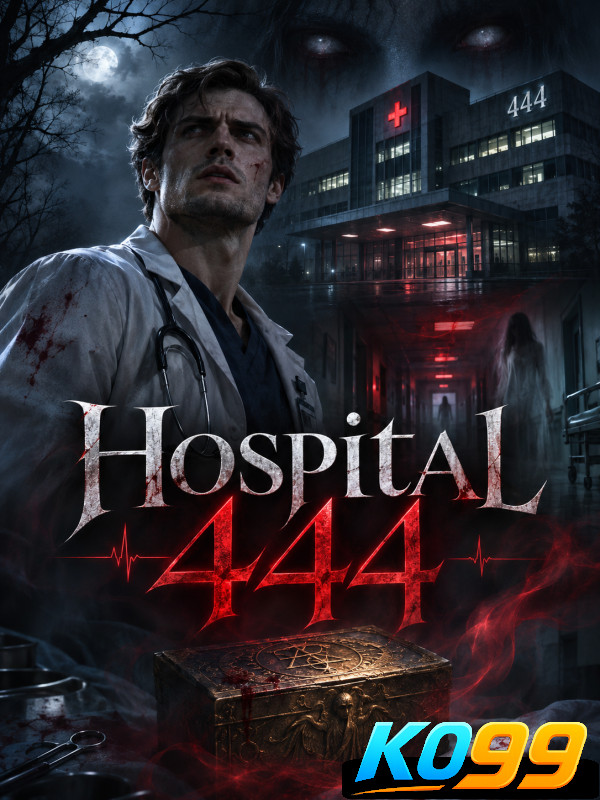
Dr. Adrian Hale thought he understood the limits of medicine—until a mysterious offer draws him into Hospital 444, a place where ordinary diagnoses mean little and every patient may be carrying a deadly curse. Behind its locked wards, doctors confront restless spirits, forbidden rules, and supernatural conditions that cannot be treated with conventional medicine. Each case forces Adrian to weigh a patient’s life against the terrifying price of intervention, while strange incidents hint that the hospital itself is hiding a much darker purpose. As the boundary between the living and the dead begins to fracture, Adrian must uncover the truth before he becomes another patient who never leaves.



Chapter 1: The Hospital After Midnight
"You have been selected to participate in Hospital 444's fourth-quarter physician recruitment program. Our hospital specializes in treating curses caused by supernatural phenomena. Applicants who pass the selection process will become resident trainees at this institution. Refusal is not an option." Adrian Hale received the text just after waking from a nightmare. In the dream, he had been lying on an operating table beneath the merciless glare of a surgical light. A figure swathed in darkness had appeared beside him, lifted a scalpel, and brought it slowly toward his eyes. He had felt the blade cut into them—felt it as vividly as if it were real. Even now, awake, his eyes throbbed. Adrian was a surgeon. He had performed more operations than he could count, but he had never experienced the other side of the operating table quite like that. Then his phone, lying beside the bed, had chimed with the message. He deleted it without a second thought. A hospital that treated supernatural curses? It sounded like advertising for some cheap online game. "Still," he murmured, "that dream was a little too real." He was resting in the physicians' lounge at Westhaven Medical Center, trying to recover his strength before a difficult operation scheduled for that evening. Unfortunately, the discomfort in his eyes was growing worse. Ophthalmology wasn't his specialty, and he couldn't immediately identify what was wrong. *I just hope it doesn't affect the surgery.* ... Late that night, the operating-room doors finally swung open. The patient, still under anesthesia, was wheeled out on a gurney. Adrian followed, exhausted behind his surgical mask. "Doctor? How did it go?" A family member hurried toward him. "Overall, the operation went well," he said. "We'll still need to monitor the patient closely in the hospital." Before the procedure, Adrian had gone back to ophthalmology for another examination. Nothing abnormal had been found, and the pain had subsided, so he had decided to go ahead. The operation was so difficult that he was the only surgeon on staff willing to undertake it. Even his former mentor had been reluctant. "Thank you, Doctor. Thank you so much!" Relief seemed to drain the strength from the family member's legs. They seized Adrian's hand, trembling. They had been warned that the tumor was in a dangerous position and that the patient might not survive the operation. Despite his fatigue, Adrian felt a familiar rush of satisfaction. He had pulled another life back from the brink of death. A few nurses emerging from the operating room watched the scene. "That's Dr. Hale for you. I can't believe he pulled off a procedure that complicated." "He's one of the youngest surgeons here to operate independently." "And the location of that tumor was terrible. Most surgeons wouldn't have touched it. He started an accelerated university program at sixteen, finished medical school and his surgical training ahead of schedule, and now he's handling cases like this." "Remember the earthquake relief effort? He was the first to volunteer." "Not even thirty, and he's already performing operations most people wouldn't attempt. I heard the hospital wants to send him to present at a national surgical conference." "Speaking of which, wasn't something wrong with his eyes today? Someone in ophthalmology said he came in for an examination this afternoon. He wouldn't go ahead with surgery until they cleared him." "Probably just overworked. He spends too much time staring at screens." Later, on the inpatient floor, Adrian sat at a computer reviewing test results for several postoperative patients. He was on call that night, and there were still cases whose recovery required careful monitoring. The strange sensation returned soon after the operation. The pain grew sharper, concentrated around his pupils. He picked up a bottle of eyedrops and put a few more drops into each eye. "Still bothering you?" asked Dr. Fletcher, a colleague sitting nearby. "What did ophthalmology say?" "I went over there. They did a slit-lamp examination and an ocular ultrasound. The lenses and retinas looked normal. Dr. Lewis couldn't find anything wrong. He thinks it's eye strain and told me to use drops for a few days." "You've been working yourself into the ground. Why not take some time off now that the surgery's over?" "Maybe I have been overdoing it, but it's nothing serious. Several patients are still unstable after surgery, especially tonight's. Removing the tumor was only the first step; we have to watch the recovery before we can say how things will turn out. If I take leave now, I'll only worry about them." Dr. Fletcher sighed. "You're the hardest-working surgeon in the place, and everyone knows it. Once this stretch is over, finish that paper on pulmonary tumors. Get it into a respected medical journal, build up a few more years of clinical and administrative experience, and you could be in the running to head the surgical department." "I'd rather gain more experience first. Research and clinical practice should strengthen each other. I'm still young. There's a lot I need to learn." "That operation today was genuinely dangerous, Adrian. If anything had gone wrong, the family might have blamed you. They might even have convinced themselves the patient would have lived longer without surgery. Doesn't that frighten you?" "I remember the oath I took in medical school. As a doctor, I—" A terrible stabbing pain ripped through both eyes. Adrian squeezed them shut, unable to open them no matter how hard he tried. Then, as abruptly as it had come, the agony receded. When he opened his eyes again, the world looked impossibly clear. Even the computer screen no longer bothered him. It was as though someone had replaced his eyes with an entirely new pair. He stared in astonishment. "Adrian? Hey, are you all right?" Dr. Fletcher asked. "I'm... fine." "All right. I'm going to make my rounds. If it starts again, visit a specialist eye center. Their ophthalmology department has more resources than ours. Oh, I'm leaving my phone here to charge. If you need me, call the nurses' station on the eighth floor." "Sure. Thanks, Doctor." Once Dr. Fletcher had left, Adrian was alone in the office. He glanced around, marveling at the change in his vision. Despite the dim lighting, he could clearly make out a fly perched on a desk at the far end of the room. "D-doc... tor... Haaale?" An elderly voice sounded from the doorway. Adrian looked up. An old man in a hospital gown stood there, bald, nearly toothless, and unsteady on his feet. His words came out thick and slurred. Adrian recognized him immediately. Mr. Barrett was a patient in Room 413, receiving chemotherapy and radiation treatment. His condition was far from stable. "Mr. Barrett, you shouldn't be wandering away from your room." Adrian frowned. Where were the nurses? Who had allowed a frail patient in such poor health to roam the hospital alone? "D-doc... tor... I'm... lookin' for... my... s-son..." Adrian remembered that the man's son had visited only once since his father was admitted. He hadn't appeared again. Between the patient's age, a surgery the previous year, and his ongoing treatment, some confusion would hardly be surprising. "Your son isn't here, Mr. Barrett. Let me call someone to take you back." Adrian rose, but before he could approach, the old man spoke again. "Th-then... I'll... look... someplace... else..." He turned and shuffled out of the office. Adrian followed immediately—only to find the corridor empty. That made no sense. The man could barely walk. How could he have disappeared in the time it took Adrian to reach the doorway? Adrian searched the nearby halls without finding him. Growing alarmed, he went to the nurses' station. "Please contact the fourth-floor station. A male patient in his seventies has left Room 413. He may be disoriented. Ask them to look for him." A fall could be disastrous for someone in his condition. Adrian would have joined the search himself if he hadn't been required to remain on duty in the office. Not long after he returned, the desk phone rang. "Hello?" "Dr. Hale? This is the fourth-floor nurses' station. We've checked Room 413. All the patients are in bed. Nobody has left." "What?" Had Mr. Barrett somehow returned already? For no reason Adrian could explain, he thought of the strange text message. "You're sure?" "Positive. The patient you described is lying in his bed." Adrian let out a breath. At least the man was safe. He returned to the records on his computer. He couldn't have said how much time passed before he heard it again. "D-doc... tor... Haaale..." Adrian's head snapped up. Mr. Barrett stood in the doorway. Again. How had the fourth-floor staff let him wander up here a second time? "D-doc... tor... I'm... lookin' for... my... s-son..." Every syllable matched the first visit. The pauses, the slurring, even the man's tone were identical. Pain stirred faintly in Adrian's eyes. He studied the old man. The posture was the same. So were his expression and the angle of his head. Adrian was surprised he remembered the details so precisely; somehow, he sensed that his altered vision had something to do with it. Then he noticed the one difference. Mr. Barrett wasn't standing in exactly the same place. This time he was about three feet closer. Adrian said nothing. He simply watched. A moment later, the man opened his mouth. "Th-then... I'll... look... someplace... else..." The same words. The same broken rhythm. Exactly the same. Adrian got to his feet and stepped into the hall. There wasn't a soul in sight. A cold unease settled over him. He hurried back to the desk and called the fourth floor. "I'm sorry to trouble you again, but please check Room 413. And make absolutely certain it's the patient himself. He just came to see me again." Even as a physician, Adrian was beginning to entertain possibilities he would once have dismissed as absurd. The nurse called back soon afterward. "Dr. Hale, he's still in bed. I'll have someone keep watch outside his room, just in case." "Thank you." Adrian hung up, chilled to the bone. He was on the tenth floor. Even if someone sprinted down the stairs, they couldn't reach the fourth floor that quickly. Certainly not an elderly cancer patient who could barely stay on his feet. And if Adrian stayed here, would the man come back a third time? Another detail struck him: if Mr. Barrett moved just three feet closer on his next visit, he'd be standing right beside Adrian's desk. Adrian looked toward the other workstation. Dr. Fletcher's phone was still charging there. Fletcher himself was making rounds. An idea took shape. Adrian called Fletcher's phone from his own. When the unattended phone began ringing, he picked it up and answered. Then he closed the office door, took his own phone, and hurried around a bend in the hallway—a corner that led to neither the elevators nor the stairs. He kept the call connected, holding his phone to his ear. His heart hammered. The ache behind his eyes intensified. Then, at last— "D-doc... tor... Haaale?" The voice came through the phone with startling clarity. But Adrian wasn't in the office anymore. "D-doc... tor... I'm... lookin' for... my... s-son..." The voice seemed to be drawing closer to the phone. The words, however, hadn't changed at all, despite Adrian's absence. "Th-then... I'll... look... someplace... else..." The final words deepened into something cold and sinister. Adrian sucked in a breath. A supernatural curse. Was that text message actually telling the truth? He ended the call and ran for the emergency stairwell. Was Mr. Barrett still lying in his hospital bed? Footsteps sounded behind him. They were slow, almost shuffling, yet somehow they grew louder and closer with every second. "Where... is... my... s-son...?" Adrian ran harder. But the stairwell never came into view. No matter how fast he moved, the corridor seemed to stretch ahead of him without end. Then a pair of hands seized the back of his neck. He couldn't take another step. His head began turning, forced inch by inch toward whatever stood behind him. Every instinct in his body screamed to survive. Adrian's eyes flew wide. Something detonated inside his mind. Two vast, bottomless spaces opened within his consciousness, as though his eyes had become twin black holes. And from those impossible depths came a terrible, irresistible pull.