
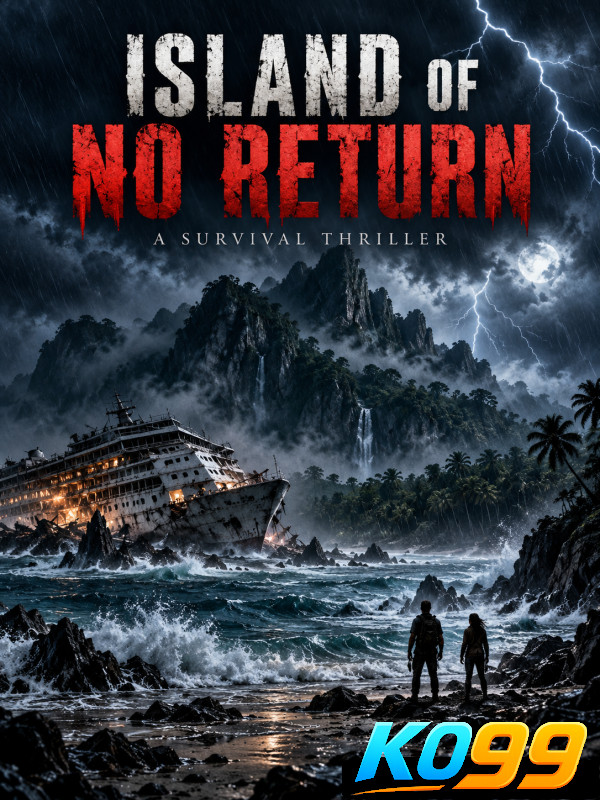
Aiden Reed boards the MV Voyager searching for answers about a tragedy that still haunts him. Instead, a violent storm sends the cruise ship off course, leaving hundreds of passengers stranded on a remote island. Rescue never comes. Food runs short, strange creatures emerge from the darkness, and a devastating explosion destroys their last hope of escape. As fear begins to tear the survivors apart, Aiden suspects their ordeal was no accident. Someone has been guiding them toward this place from the very beginning. To survive, he must uncover the island’s secrets before the forces watching from the shadows turn their desperate struggle into a deadly game.



Chapter 14: Mayflies
Night drew its curtain across the world, stealing the sunlight and leaving the cities in shadow. But humanity had never stopped fighting back against the darkness. The struggle began in the age of slash-and-burn farming, when sparks struck from stone kindled the first fires. Later, people learned to coax flames from dry sticks drilled against dead wood. Little by little, they mastered the use of fire. Over thousands of years, those first flames gave way to torches and then candles. Even the humble candle underwent one refinement after another. Then came the Industrial Revolution. Electric lights began replacing traditional oil lamps, and before long, they were everywhere. As human settlements grew larger and more crowded, scientific progress brought light to places that had once been swallowed by darkness. In the modern age, cities remained ablaze with lights even at three or four in the morning. Their brilliance lasted until dawn. It had seemed like the height of human civilization—an age of dazzling wealth and endless indulgence. Yet progress, like the arc of a parabola, had another side. Once that curve reached its highest point, it began to fall. The descent was gradual at first, but it led inexorably back toward the abyss. It had taken humanity two hundred years to pass through the industrial age, then another fifty to reach the modern era. And from that turning point, fewer than twenty years had been enough to usher in the age of artificial intelligence. Artificial intelligence was built around computers capable of deep learning. They could devise their own algorithms, creating something akin to a thinking brain. The revolution it brought was impossible to miss. Equipped with powerful algorithms, AI could take over an ever-growing share of the work once performed by people. Grocery stores, for instance, no longer needed cashiers. Customers selected what they wanted, and the system handled checkout automatically, eliminating the usual human labor. Banks, hospitals, and other service providers followed suit. Robots fitted with AI chips could replace doctors, drawing on stores of medical knowledge and levels of surgical precision that human practitioners simply couldn't match. In both efficiency and cost, artificial intelligence had left traditional skilled labor far behind. As society embraced these changes, large numbers of skilled workers lost their jobs. And losing a job meant losing a dependable income. The cities that had blazed with light a decade or so earlier began to grow dim. The darkness, however, spread mainly through their sprawling outskirts. In the central districts, technology had reached heights people wouldn't have dared imagine a little over a decade earlier. Skyscrapers pierced the clouds. Near Blackwater Harbor stood a port-monitoring building where two employees were struggling to stay awake on the night shift. AI handled virtually every task. Their job, for the most part, consisted of sitting in the control center and trying not to fall asleep. “Man, listen to that rain. This has gotta be the biggest typhoon we've had all summer. Who'd want to go outside in weather like this?” The speaker was tall and skinny. He yawned again as he scrolled through celebrity gossip and entertainment posts on his phone, looking thoroughly bored. “Who cares how bad it gets out there? We're not gonna feel a thing in here. This whole building's climate-controlled. Nice and comfortable. Why would anybody want to leave? That's the beauty of the AI age. The machines do everything, and we just sit back.” His stockier coworker was absorbed in a video game. Snacks and drinks covered the desk in front of him, and despite the late hour, he was wide awake. “Still, I heard they laid off six more people in the technical department yesterday. There are only four of us left now, including you and me.” The skinny man let out a sigh. A trace of worry crossed his face, followed by a look of weary resignation. “Well, of course they're cutting staff. AI makes everything easier. It's not just us, either. A bunch of places around the harbor are laying people off.” The heavyset man barely glanced up. “But relax. My brother-in-law's the director of the Port Authority. With him looking out for us, there's no way we'll be the ones getting fired.” He picked up a hamburger, took another greasy bite, and turned his full attention back to the game. He didn't seem remotely troubled by the layoffs. After all, he had connections he could count on. In an age when artificial intelligence was taking over everything, perhaps people with the right connections were the only ones who could still be sure of keeping their jobs. “They won't fire us, huh? Well...” The skinny man sighed. Then he looked up sharply. “Hey, wait a second! Look at this! Where did the MV Voyager go? It's vanished from the tracking system!” His smile had turned bitter. Unlike his carefree coworker, he knew there was more to worry about than the next round of layoffs. Then an alert caught his eye. He opened it and discovered that the automated monitoring system had flagged an anomaly involving the Voyager. The cruise ship should have been following its scheduled route. Instead, it had vanished from the tracking display without a trace. That made no sense. “How does a whole ship just disappear?” the other man asked. “Maybe the system's glitching. I've never seen anything like this since I started working here.” He paused his game, looking mildly surprised, then wandered over to the instruments without much urgency. “No. Something's wrong. Really wrong. The Voyager is gone. It's completely off the screen!” The skinny man kept checking the data, his voice rising. “We have to report this upstairs. Right now. This is serious!” He searched through the readings again and again. There was no sign of the ship anywhere. How could a cruise liner weighing tens of thousands of tons simply vanish from its assigned route? News of the Voyager's disappearance began spreading through Blackwater City, sending ripples outward like a stone dropped into a pond. Meanwhile, hundreds of miles away, the missing liner was being tossed across a vast, storm-lashed sea. The waves kept climbing higher. The Voyager, which had barely managed to stay afloat and moving before, was now pitching and rolling violently. At one point the vessel heeled more than sixty degrees, throwing it dangerously off balance as seawater swept across the decks. Cries and screams rose from inside the ship. There was no time left for arguments or questions. Everyone aboard understood that the Voyager was facing a catastrophe. Its systems had failed one after another. With most of the ship's vital functions disabled, the vessel was at a terrifying disadvantage against the storm. “Get over there and help! Don't just stand around! Women, back to your cabins and stay there! Men, we need all hands out here! Move!” “We've got water coming in over there! Damn it, the AI's completely down! Are there any engineers? Where the hell are the engineers?” “We can't just let ourselves die! We've gotta do something! Everybody, move! Hold on—hold on tight!” Orders, shouts, and panicked voices tangled together throughout the cabins. Ornate brass chandeliers swung wildly with the ship's movements. People stumbled and lost their footing. All they could do was grab whatever was within reach and cling to it as the waves battered the hull. Beyond the windows, walls of water came crashing down. In several cabins, the glass shattered and seawater poured inside. Engineers rushed to those rooms and secured the doors as tightly as they could, trying to keep the flooding from spreading farther into the ship. “We need more people over here! Come on, give us a hand! I don't know what the hell's happening, but we're not dying here!” “You've gotta be kidding me! I came on this trip for a vacation! I'm not ready to die, and I'm not giving up!” “Block that opening! I've almost got this side! I haven't even told the girl of my dreams how I feel yet. No way am I going down now!” For all the danger the Voyager faced, the people aboard were pulling together, doing everything they could to survive a disaster none of them had seen coming. The wind and rain continued their assault on the steel-hulled giant. Waves more than thirty feet high rose around it, threatening to swallow the ship at any moment. Yet the Voyager kept fighting its way through the heaving sea. Somehow, it refused to capsize. Hundreds of people had staked their will to live on that one vessel. Against the vastness of the ocean, human beings might be as insignificant as mayflies beneath a tree. But that didn't mean they would stop fighting.