
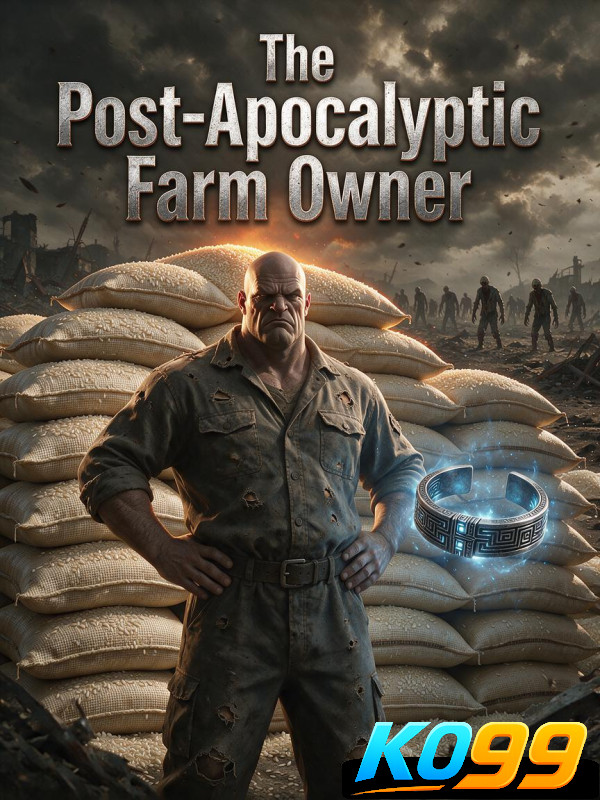
Li Ba, a graduate of Huaxia Agricultural University, was the sales manager at a well-known seed company in Wucheng before the apocalypse. When the apocalypse struck and order collapsed, the naturally timid Li Ba faced life-and-death situations and managed to scrape by and survive. By chance, he set aside the rules of post-apocalyptic survival to save a grandfather and his granddaughter, and in return, he received a magical bracelet. The bracelet contained a universe within—a plot of land, a stone trough brimming with spring water, and a Tower—all of which opened up a mysterious realm for him. What to do when food runs out? “My Fengshou Group has mountains of grain—I’ll trade it for crystal cores and jade!” Li Ba declared arrogantly. What to do when zombies attack the city? “The mutated plants cultivated by ‘Lord Ba’ can withstand a tide of a million zombies!” Li Ba said with absolute confidence. What if you’re not an Evolver and someone challenges you to a one-on-one duel? “I’ve got talismanic soldiers guarding me. Anyone who dares challenge me will get beaten so badly, even their own mother won’t recognize them!” said Li Ba, his bald head revealing a menacing expression as he spoke viciously. Using the mysterious space and his expertise, Li Ba cultivated crops and tended fields, determined to become a major farmer in the world of *Horse Herding* and pursue a happy life in the post-apocalyptic world.



Chapter 1: Rules
for Survival in the Apocalypse “This damn apocalypse!” Dragging his utterly exhausted body, Li Ba walked out through the city gate and looked up at the sky. It was already late afternoon, yet the Sun still hung high like a blazing furnace, scorching the earth. Beyond the city gates, a shantytown stretched as far as the eye could see, spanning seven or eight li. Everywhere, disheveled, emaciated people huddled inside makeshift huts built of wooden planks and tree branches, their eyes vacant and lifeless, devoid of even a spark of vitality. He glanced back at the city gate, where men in camouflage uniforms stood on either side, guns in hand. A flicker of envy crossed Li Ba’s eyes. He sighed, then dragged his leaden legs, step by step, toward the shantytown. “When will I ever be able to leave this refugee camp… and go into the city!” The Mayan prophecy had predicted that December 21, 2012, would be the end of the world, but on that day, nothing happened—everything went on as usual. Afterward, the Mayan prophecy was dismissed as nothing more than a joke told over drinks or at the dinner table. Who could have imagined that, just one year later, the end of the world would actually come to pass? First, the sun and moon vanished, and darkness enveloped the earth. After people spent seven days in panic and anxiety, the Sun and moon returned, accompanied by an unknown virus spreading across the globe. In just a few days, nearly half the world’s population was infected by the virus, turning into deranged living dead who fed on the flesh and blood of survivors—known as zombies. That day happened to be December 21, 2013. The Mayan prophecy had not been wrong—it was merely slightly off; the end of the world arrived exactly one year later. Li Ba, 27, was a graduate of Huaxia Agricultural University and, before the apocalypse, the manager of the business development department at a well-known seed company in Wucheng. That day was supposed to be a joyous occasion—he had just defeated several competitors to win the position of business manager, and the company was hosting a cocktail party to celebrate. Who could have predicted that the damned apocalypse would strike? Nearly half of the more than 300 colleagues were infected with the virus and instantly turned into zombies. What happened next goes without saying: as the zombies chased and slaughtered them, fewer than a hundred survivors remained, holed up in the large conference room, waiting for government rescue. After enduring panic, darkness, hunger, and despair, the darkest and ugliest aspects of human nature erupted. Li Ba witnessed with his own eyes someone pushing his girlfriend into the horde of zombies to save his own life. Others, driven to the brink of starvation, killed their own best friends and fed on their flesh and blood—and so on. Had his will not been relatively strong, he would have long since been driven mad by the madness unfolding before his eyes. Survival is what matters most! He repeated this phrase to himself over and over again. Finally, he survived and waited for the government to dispatch troops to rescue and evacuate the survivors from Wucheng. With the outbreak of an unknown virus and the apocalypse upon them, the government was clearly caught off guard, having underestimated the destructive power of this disaster. Although the military possessed heavy weapons such as machine guns and artillery, they still struggled to withstand the onslaught of the hundreds of thousands of zombies in Wucheng and were forced to retreat step by step. However, they managed to clear a path, allowing the survivors to escape to safety. Under military cover, Li Ba followed a group of more than 5,000 survivors as they fled Wucheng. Their respite was short-lived, however, as the zombie horde gave chase. The troops suffered heavy casualties, and the group of survivors was scattered. Li Ba narrowly escaped death by sheer luck and joined a small group of refugees, fleeing aimlessly. Along the way, this group of 500 refugees faced one calamity after another—zombies, mutated beasts, and repeated attacks—suffering heavy casualties, as well as hunger and disease. In the end, fewer than 200 survived. Li Ba was one of them. It must be said that he was lucky: just as they were running out of ammunition and food, they arrived at a settlement established by survivors—the Xibu Settlement. When the apocalypse struck, an unknown virus swept across the land. Some people were transformed into zombies by the virus, while others developed immunity and resisted its invasion. Among them, a very small number experienced genetic mutations as their immune systems fought off the virus, granting them all sorts of incredible powers. This tiny fraction of people came to be known as “Evolvers.” Evolvers possess strength surpassing that of zombies while retaining all the characteristics of their original human selves; they can be considered a new breed of humanity. Under their leadership, numerous survivor settlements have sprung up across the shattered land of Huaxia, and Xibu is one of them. Located southwest of Wucheng, Xibu was originally a small town with 20,000 to 30,000 permanent residents, surrounded on three sides by mountains and situated in a strategically defensible location. After the apocalypse struck, survivors from the surrounding areas poured in. Led by a detachment of Armed Police officers who had lost contact with their command and a group of powerful Evolved, they eradicated all the zombies in the area, built city walls, and established a settlement. When Li Ba’s group of one hundred arrived, they underwent a screening process. Several individuals who demonstrated the potential to become Evolvers were granted entry, along with their relatives and friends, who were given preferential treatment. A few others with specialized skills were also permitted to enter. The remaining majority of survivors, including Li Ba, were turned away. In the words of the Xibu settlement’s officials, resources here are limited, and they cannot support too many people. To survive, one must rely on oneself. A large number of survivors, having been turned away, refused to leave and instead settled down, forming the refugee camp that exists today. Compared to the zombies roaming the wilderness and the ferocious mutated beasts, the area outside Xibu City is undoubtedly much safer; even without food or water, the survivors are determined to stay here. The authorities of the Xibu Settlement have not driven out the refugee camp; instead, they have pointed out a way for them to survive. There are numerous villages surrounding Xibu, and a small county town lies twenty kilometers away. While the surrounding area is rich in supplies, it is also teeming with zombies. As long as one is brave enough, they can venture out to gather supplies and survive. Furthermore, by killing zombies to obtain the crystal nuclei inside their bodies, or by bringing in the carcasses of mutated beasts, survivors could trade them with the Xibu settlement authorities for food—and even earn the opportunity to live within the city walls. At the same time, since the settlement had only recently been established, there was a need for manpower to build city walls, till the fields, and perform other manual labor. As long as one was willing to contribute their labor, they could receive daily rations to survive. To survive, you’re on your own! Li Ba knows better than anyone just how formidable the zombies are. Even the most common zombies possess twice the strength and 1. 5 times the speed of an ordinary person—killing them is no easy feat! Mutant beasts were even more terrifying; for an ordinary person to encounter one, death was the only outcome. Li Ba knew his own limitations. He stood 1. 82 meters tall and weighed 85 kilograms; the hardships of post-apocalyptic life hadn’t made him much thinner. With a round face, a waist over three feet in circumference, and a bulging belly, his body was heavy and his movements sluggish. His survival was purely down to good luck; trying to kill zombies or mutated beasts was nothing short of a pipe dream—it would be courting death! Therefore, he had no choice but to sell his labor for hard manual work, trading it each day for two bran buns just to scrape by and stay alive. Going hungry every day while doing heavy labor—this kind of life made Li Ba feel as if he were worse off than dead. But when he finished work and returned to the refugee camp, looking at those emaciated, unrecognizable refugees, he actually felt a slight sense of superiority. Doing manual labor depends on your physical condition. The elderly, the weak, the sick, and the disabled were all unqualified—after all, if they were to die of exhaustion on the job site, someone would have to collect their bodies, which would be a hassle! Following the stench-filled path, sensing envious glances from both sides, Li Ba unconsciously straightened his back and strode forward. Arriving at his quarters—a shack built of wooden planks—he was just about to push open the door when he suddenly frowned and turned around. Several disheveled, filthy women had gathered around him. “Master Ba, give me half a steamed bun, and I promise to make tonight unforgettable for you!” One woman struck a seductive pose, her face beaming with flattery. “All I want is… just a tiny bit of steamed bun, and I’ll spend the night with you—singing, dancing, playing instruments—whatever you want!” Another woman ripped open her bodice, exposing her shriveled, emaciated breasts, and looked at Li Ba with eager anticipation. “You filthy bitch, daring to steal business from me—don’t you want to live anymore?!” “What’s the matter? Want to fight? I’m not afraid of you!” The women’s intentions were obvious. Before the apocalypse, they might have been wealthy heiresses or corporate executives, but now they’d let men toy with them for half a piece of bran bread—and at that moment, they were already wrestling in a heap. “All of you, get the hell out of here!” A look of disgust crossed Li Ba’s face as he pushed open the door and slammed the wooden door shut with a loud “bang.” “Master Ba, please, give us something to eat… My son hasn’t eaten in three days—he’s about to starve to death!” Just as the door closed, the wailing cries of women came from outside, each one sounding more pitiful than the last. Li Ba heard them, but his face remained completely expressionless. The number one rule of survival in the apocalypse. To show mercy to others is to be cruel to yourself! He was barely surviving himself—how could he possibly part with his last bit of food to help these strangers? The cries for help soon faded away. The women outside likely realized that even if they screamed themselves hoarse, they wouldn’t get a single morsel of food. After the footsteps faded into the distance, Li Ba fished a plastic water bottle—half-filled with water—out from the corner of the dimly lit room. Then, he pulled a palm-sized steamed bun from the inner pocket of his Armani suit and began eating it in small bites. He’d bought this Armani suit before the apocalypse—gritting his teeth and spending several months’ salary to celebrate his promotion to sales manager. On the day the apocalypse struck, he’d made a point of wearing it to the company cocktail party. From that day on, he’d never had the chance to take it off; now it was tattered and filthy. As the name suggests, bran buns are made by mixing rice bran with a small amount of flour. What had been pig feed before the apocalypse was now a delicacy; with every bite, Li Ba chewed slowly and thoroughly, his face betraying an expression of pure enjoyment. When he had eaten half of the palm-sized bun, he carefully tucked it away, intending to save it as a late-night snack to enjoy in the wee hours of the morning. He had no choice—he was big and burly, with a hearty appetite and a fast metabolism. If he ate the whole bun, he’d surely be too hungry to sleep by the middle of the night. If that happened, he’d have no energy for tomorrow’s work and would once again be tormented and mocked by that despicable guy. After taking a sip of water, Li Ba lay down directly on the bed cobbled together from wooden planks, remained motionless, and began to drift off to sleep. He had to conserve every ounce of energy to cope with tomorrow’s labor and survive. Before long, snores filled the air, and Li Ba drifted off to sleep. In his dreams, he seemed to see himself back at the most luxurious five-star restaurant in Wucheng, ordering a table full of delicacies, flanked by two beautiful women, and feasting heartily while sipping red wine. In the aftermath of the apocalypse, the only moments of true happiness for him were when he was asleep, lost in sweet dreams.