
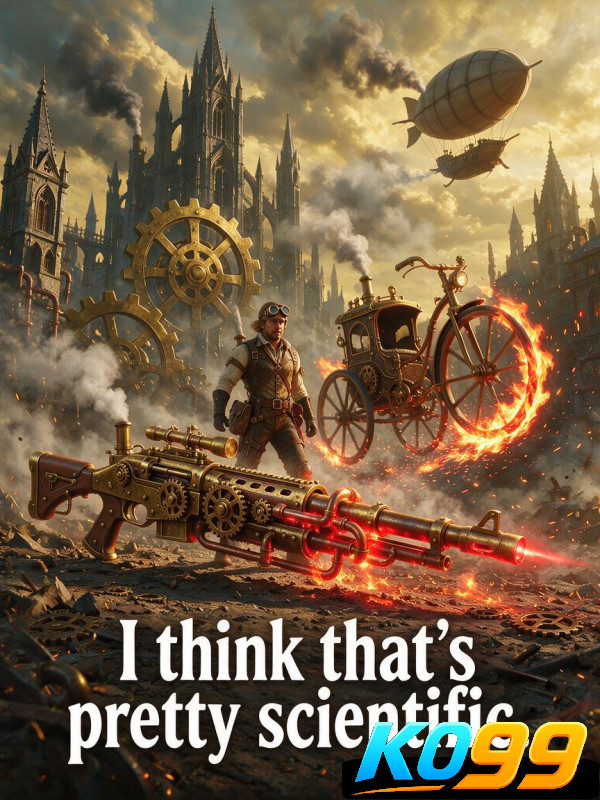
A time traveler arrives in the Multiverse with an ability that turns confident assumptions into reality. If he believes an ordinary object should perform an impossible task, the rules of the world may simply adjust to make it happen. A bicycle can rise into the sky, common equipment can behave far beyond its normal limits, and even the human body can ignore expectations that should be absolute. The power sounds convenient, but every new idea raises a larger question: if reality keeps obeying what he thinks is “scientific,” how long will it be before no one—including him—can tell where logic ends and imagination begins?



Chapter 2: 002: Dr
Crafty Hands Kraft Lee, male, is about fourteen years old this year. Seven years ago, he was abducted by the Magia Gang from an unknown location. The Magia Gang subjected him and a large group of other captives to repeated human experiments. After one such experiment, Kraft began having recurring dreams—all of which featured a group of strangers, and even other creatures, engaged in various inventions and creations. At first, these dreams were not only fragmented and chaotic but also unending, leaving Kraft in a dazed and confused state for a long time. Furthermore, with such a massive influx of information into his young mind, he developed a high fever. Then, while he was in that half-asleep, half-awake state, something must have gone wrong at the Magia Gang’s facility—somehow, the captives found an opportunity to escape from their experimental base. In a rare moment of clarity, he clung tightly to a fellow yellow-skinned boy and was luckily brought out with them. The person he clung to was none other than Kraft’s current adoptive father, Martin Lee. Whether it was due to the experiments or the sheer volume of information implanted into his dreams, when Kraft finally emerged from his dazed state, his memories prior to being captured by the Magia Gang had vanished. He couldn’t even remember his own name, since, as a test subject, he had been assigned only a simple numerical code while with the Magia Gang. So Kraft took Martin’s surname and, based on the content of his dreams, gave himself the name “Craft.” Actually, the first name that came to mind was “Lovecraft,” but for some reason, he always felt there was something off about it, so in the end, he dropped the “Lov” from the beginning. At first, after escaping the Magia Gang with Martin Lee, the two didn’t even have any identification. Although a fake driver’s license was enough to fool most authorities in the United States, their Asian heritage often subjected them to extra scrutiny. Eventually, they made their way to New York’s Chinatown, where they gradually gained a foothold thanks to the support of other members of the Chinese community. Once they’d settled in, their lives suddenly took a turn for the better, as if someone were looking out for them. Martin Lee was even personally awarded the Medal of Freedom by the president, granting him and Kraft genuine legal status. Even so, Kraft still didn’t have the slightest bit of goodwill toward white or Black people, nor did he care much about his U. S. citizenship. His greatest wish was to one day save enough money to return to the other side of the ocean. So when Martin Lee spent a large sum of money to buy the clothing store where he had once worked and converted it into the FEAST homeless shelter, Kraft had a huge argument with him. But as Kraft grew older, his extreme views began to soften, especially after he met several kind-hearted white and Black people. Although Kraft still found it difficult to warm up to people of other skin colors, he no longer condemned them all with a broad brush. As his life gradually improved, Kraft began trying to recreate the inventions and creations from his dreams. Although his dreams were fragmented at first—making it impossible to make sense of their content—as Kraft emerged from his dazed state, his dreams gradually became coherent and complete. However, he had absolutely no control over when he would dream or what those dreams would entail. Moreover, due to his own limited knowledge and technical skills, there were many things Kraft simply couldn’t understand—he couldn’t even manage to copy them exactly. On top of that, Martin kept a tight rein on his allowance, so even if Kraft wanted to try out the inventions from his dreams, he didn’t have enough money. Until one day, Kraft dreamed of an elderly man from Huaguo dressed in ancient attire. The man claimed to be a disciple of the Mohist school. In the dream, the old man was crafting all sorts of strange and wondrous little gadgets from a pile of wood while teaching a group of children a technique called “mechanical art.” After waking up, Kraft took out his meager savings, bought a few basic carving tools, and gathered some scrap wood. He tried his hand at making the simplest mechanical lock, then took it to school to bet with his classmates on who could unlock it—earning his first small fortune. Although it wasn’t quite enough to cover the cost of his tools, Kraft was still very happy. Later, he went out of his way to look up records about the Mohist school, but there were no relevant books to be found in the United States. Finally, after wandering around Chinatown and asking an elderly doctor at a Chinese herbal medicine shop, he learned what the Mohist school was all about. Unfortunately, he only had two dreams about the Mohists before they gave way to dreams that left him completely baffled… A phoenix folded out of paper can actually breathe fire! Are you serious?! No matter how limited Kraft’s knowledge might be, he could tell that some dreams simply didn’t take place in his own world… Who looks like a sheet of paper? And everything in that world is made of paper… That’s just not scientific at all, right?! Later, Kraft had a few scattered dreams about the Mohists’ mechanical arts, but the old man was no longer the protagonist—and the world might not even have been the same one. Kraft could understand making mechanical puppets out of wood that performed repetitive movements, but crafting a mechanical tiger out of wood, carving a few glowing runes into it, and having it move freely—even speak like a human—wasn’t that taking things a bit too far? However, even though he often encountered dreams he couldn’t make sense of, Kraft managed to earn a fair amount of money by replicating other small gadgets. Later, Fat Liao even came knocking on his door seeking a partnership: Kraft would handle production, and Fat Liao would handle sales. Liao the Fat lived up to his reputation as the young master of a shady shop, and Kraft’s income skyrocketed overnight. Later, Kraft dreamed of a long-haired man who called himself “Handicraft Geng.” Inspired by him, Kraft began filming the creation process of some of his works and posting the videos online, adopting the username “Dr. Crafty Hands.” With the help of Liao the Fat Guy—a self-proclaimed business prodigy—Kraft’s “Skilled Hands” channel has now gained some recognition. His products are not only hugely popular in nearby schools but are also generating a steady stream of online orders. Recently, he even rented a warehouse in Chinatown with the intention of converting it into his own private workshop; he’s just waiting for the equipment he ordered to arrive. Chatting and laughing all the way, the school bus arrived at Fantas Public Middle School, where Kraft attends. With Fat Liao slung over his shoulder, Kraft stepped off the bus and headed toward the seventh-grade classroom. The curriculum in American public schools isn’t particularly demanding, and most teachers here aren’t in the habit of pushing students to study; they place greater emphasis on fostering students’ independence, believing that academic issues are something parents should be concerned with. However, since Kraft wanted to better understand the content of his dreams, Martin didn’t need to worry about his studies. Although, more often than not, the knowledge gained at school was completely useless in his dreams… As for techniques like casually igniting flames to melt metal, then summoning lightning out of thin air to forge it into a flying sword—even if Kraft mastered every bit of knowledge in the Library of Congress, he’d still be unable to pull that off. It seems I’m destined to follow the path of technology in this life… Kraft wasn’t sure why that thought had popped into his head, but he felt it was truly spot-on. As for inventions involving mystical arts, magic, and other “mystical” methods, he could only treat them as anime CGI for now—enjoying them with his eyes—but if he wanted to actually create something worthwhile, he’d have to rely on dreams related to pure technology. Take Dr. Agasa, whose real name is actually “Doctor,” for example—whether it’s the anesthetic watch or the power-boosting shoes, they’re all fantastic inventions. With that in mind, Kraft touched the watch on his wrist. He hadn’t yet managed to create the foot-strength-enhancing shoes, but the craftsmanship behind the anesthetic watch wasn’t difficult. The core technology was actually the anesthetic agent—which could induce rapid anesthesia and was non-toxic and harmless—but it only required mixing it in specific proportions; the manufacturing process itself wasn’t particularly challenging. The only thing that puzzled Kraft was that many of the figures associated with pure technology in his dreams were Japanese, while in reality, there weren’t many Americans at the forefront of technology. Is Japanese technology in other worlds really that advanced? To be honest, Kraft was very curious about this. After dreaming for so many years, Kraft had come to identify certain patterns. In dreams where the protagonist is from China, the scenarios usually involve things that can’t be replicated without special abilities—like alchemy or artifact forging—or crafting divine weapons and armor that are of little practical use to him. Although those legendary swords and blades capable of cutting a hair in two or slicing through iron like mud are indeed incredibly impressive, in this day and age, no matter how powerful bladed weapons are, they can’t hold a candle to guns. Plus, the material requirements are so exacting,Kraft simply can’t afford to get involved. Then there are the Japanese—the tech-savvy powerhouses—but most of them are busy building all kinds of robots. Given Kraft’s budget, he simply can’t afford to get into that kind of heavy industry manufacturing either. He rarely dreams of scientists like Dr. Agasa, who’s always inventing down-to-earth products. And while the Americans—who stand at the forefront of technology in reality—do appear in his dreams, most of them are conducting human experiments, pursuing a purely biochemical path. Kraft would absolutely never touch such dangerous nonsense. Not to mention that he himself is a victim of human experimentation; just recalling the overwhelming tide of zombies in his dreams sends shivers down Kraft’s spine. The rest were just a jumble of random dreams—races like elves, dwarves, and goblins that only exist in fantasy literature. The things they created were almost always infused with magic, frustratingly all things Kraft could only covet but never learn to make. There was also some alien technology—most of which Kraft couldn’t make heads or tails of, and much of it was completely useless to him. Take, for example, those aliens with butts on the back of their heads; the gear they made for themselves simply wasn’t suitable for humans. However, thanks to these bizarre dreams, Kraft is now not only fluent in multiple languages but can even string together a few phrases in languages he’ll never actually use, like Elvish or alien tongues. It’s pretty fun to use them to fool his classmates or pretend to be a linguist online. I posted a new book announcement on my old book page, but it showed that the series was complete and VIP chapters were unavailable… but I was posting a public chapter, for crying out loud! I finally managed to post it successfully using a mobile app, but it appeared at the very end of the public chapters—I have no idea how many people will actually see it… I kind of regret not setting up a group chat earlier…