
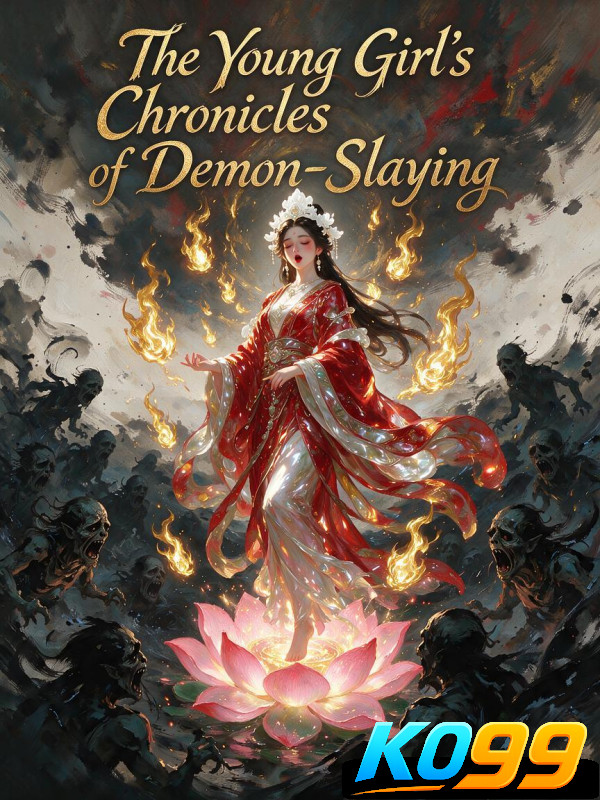
A young cultivator dressed in a jade-glazed robe travels through a world where Buddhist teachings, spiritual techniques, and restless spirits exist side by side. Though she appears calm and compassionate, her journey repeatedly brings her into places troubled by supernatural forces and unresolved resentment. Each encounter requires more than raw power: she must understand how the haunting began, distinguish hostility from suffering, and decide when confrontation is truly necessary. Her travels gradually become a chronicle of spiritual mysteries, ancient vows, and the difficult balance between mercy and the duty to protect the living.



Chapter 20: The Battle of Magic
As the night grew late, Fang Heng stopped playing with his phone and instead sat cross-legged on the bed, gazing at the sutra placed before him. Even for those with no knowledge of Buddhism, the *Diamond Sutra* is a name that rings a bell. This is largely thanks to those supernatural-themed movies: whether it’s a Taoist priest or a Buddhist monk, whenever they encounter demons, monsters, or ghosts, they simply chant the *Prajñāpāramitā* with great fervor, and the creatures vanish one by one with agonized screams. This “Prajñāpāramitā” is actually the “Subduing the Mind” chapter from the *Diamond Sutra*, commonly known as the *Heart Sutra*; the entire sutra consists of only one scroll. For the average person who isn’t a believer, even if they’ve heard of this sutra, they would never bother to learn about it—unless they’re studying Buddhism or have a particular interest in the faith. Fang Heng, of course, belonged to the category of ordinary laypeople who knew the name but were unaware of the specific content. The only reason he knew about it now was that, just before flipping through the sutra, he had done a quick search on Baidu. Simply put, the Diamond Sutra is indeed a Buddhist method for exorcising demons and dispelling evil spirits. Lin Dian had Lin Yuqin recite the sutra before going to sleep that night—perhaps because he realized she wasn’t merely having nightmares, but was actually possessed by an evil spirit. Reciting this sutra might drive the spirit away? However, Lin Yuqin was just an ordinary person who had never believed in Buddhism. Could reciting the sutra really be effective for someone like her? Or perhaps it was the sutra itself that held the power, rather than the person reciting it? After Lin Yuqin brought the sutra back, he realized she hadn’t taken it seriously. Sure enough, that evening, Lin Yuqin left the sutra book behind in the living room, while he, on the other hand, couldn’t stop thinking about it. Seeing that she had forgotten it, he took the book upstairs with him as he went. Now, what exactly was so special about him? If this could grant him the power to communicate with the Buddhist prayer beads in his hand, then he would likely have to read more Buddhist scriptures in the future. Because the *Diamond Sutra* has appeared in many supernatural and ghost-themed movies, people unfamiliar with it might assume the text is filled with spells and incantations. In reality, however, the *Diamond Sutra* is merely an overarching framework; its full name is the *Diamond Sutra of Perfect Wisdom*, and it is divided into many shorter sections. According to Baidu, even the *Diamond Sutra* has multiple translations, and he had no idea which version he was holding. However, these were all just minor details, and Fang Heng had no interest in delving deeper; he simply opened the sutra and began reading. What people commonly refer to as the *Diamond Sutra* is, in fact, much like Confucius’s *Analects*—a dialogue between the Buddha and the Bodhisattva Mahasattva. However, such dialogues often contain worldly truths and the profound wisdom of Buddhism. Ordinary people can only recite the text as written—a practice known as “chanting the sutra”—while true understanding is reserved for enlightened monks who have attained profound mastery of Buddhist teachings and spent their entire lives studying numerous sutras. Since he had already gained some understanding of the *Diamond Sutra* online beforehand, Fang Heng wasn’t particularly surprised by its contents. He simply leafed through it slowly, and every character, every sentence, was etched into his heart like a brand. As he read, he was overcome by a sense of ethereal enlightenment, as if he had suddenly grasped profound truths. Before he knew it, he had become completely absorbed in it. Just then, from the small living room on the second floor next door, a faint, ethereal cry of a baby suddenly rang out, intermingled with what sounded like a low, indistinct murmur—as if someone were chanting a mantra to themselves. The baby’s wail was shrill and piercing, like steel needles piercing his eardrums and burrowing into his brain. The man’s chanting, though clear at first listen, became increasingly indistinct upon closer attention, causing an involuntary sense of dizziness and mental confusion. Song Wencheng and Lin Yuqin, who were fast asleep, were plunged into a nightmare by the alternating sounds of the infant and the man, and they struggled unconsciously in their beds, their faces contorted with pain. The small living room on the second floor was filled with black mist, far denser than what they had seen before—so viscous it resembled sludge or tar. It flowed across the floor, seemingly slowly, yet in the blink of an eye, it had engulfed the entire second floor and was rapidly spreading to other parts of the villa. Fang Heng, who had been engrossed in his sutras just moments ago, was startled awake by this scene, which exuded intense malevolence and a foul stench. When he came to his senses, he realized the lights in the room had gone out at some point; only the Buddhist prayer beads on his right hand emitted a faint, sacred glow, illuminating a small area. As for the characters on the pages of the *Diamond Sutra* lying open before him—perhaps illuminated by the Buddha’s light—they began to glow with a golden radiance, floating above the pages like leaves on the water’s surface, moving of their own accord without disturbing the waves. Although a malevolent spirit was closing in from outside, Fang Heng’s demeanor at this moment was worlds apart from his previous reaction. He felt not a trace of fear or dread; instead, his heart was filled with compassion and rage. His compassion was for the infant, who had been born pure and innocent but was now, against its will, a ghost infant—manipulated by others to commit acts of murder and extortion for profit, a sight that stirred deep pity. His anger, naturally, was directed at the person manipulating the ghost infant from behind the scenes—someone so cold-blooded and vicious as to dare defy all moral norms by raising a ghost infant and using it to commit murder and extort money. Such actions were simply intolerable to the laws of heaven! Fang Heng’s face darkened with anger, and his Buddhist prayer beads seemed to respond, radiating an even more intense Buddhist light. Bathed in the Buddhist light, a lotus blossomed faintly between Fang Heng’s brows. He closed his eyes slightly, and though his lips moved imperceptibly, the sound of a sutra chanting drifted forth. “Avalokiteshvara Bodhisattva, while practicing profound Prajñāpāramitā, realized that the five aggregates are empty, thereby liberating all beings from suffering and affliction.” “Shariputra, form is not separate from emptiness, and emptiness is not separate from form…” “Sensations, perceptions, volitions, and consciousness are likewise.” “Shariputra, …” At first, the voice was as soft as usual, but as time passed, the sound of the recitation grew louder and louder. Before it had even reached the halfway point, the original voice had long been drowned out; what could be heard now was as if a thousand or more monks were chanting in unison. The Buddha’s light instantly illuminated the entire room and shone out through the crack in the door. Suddenly, the door swung open of its own accord. Outside, a black mist swirled—like the sludge of a foul sewer, viscous as paste and as black as ink. Yet when struck by the Buddha’s light from within the room, it melted like the first snow of winter upon encountering sunlight, rapidly dissipating and retreating back into the small parlor. As if sensing the arrival of its nemesis, the ghost infant’s wailing grew even more piercing, while the eerie chanting intertwined with it became increasingly frantic and shrill. The Buddha’s light and the black mist, the incantations and the chanting of sutras—like two powerful forces clashing—engaged in a fierce battle within the cramped little living room. Amid the Buddhist light, one monk after another—clad in saffron robes and chanting sutras—began to materialize. From within the black mist, a ghostly infant with arched eyebrows, glaring eyes, a hideous face, and boundless fury began to materialize. Raising a pair of chubby little hands, its spread fingers revealed sharp, pointed nails as it lashed out at the group of monks across from it. Countless tentacles reached out from the black mist, attempting to attack the monks bathed in the Buddha’s light; yet, under its radiance, they all began to melt like red-hot iron in water, emitting wisp after wisp of blue smoke. Amid these attacks, the monks, shielded by the Buddha’s light, continued to chant as they advanced; with every step they took, the black mist and the ghost infant retreated a step. The ghost infant glared furiously and roared incessantly, yet it could do nothing to substantially alter the situation. It was not only the ghost infant that met this fate; even the man’s deep, chanting voice—which had initially been clear and audible—became increasingly muffled, gradually drowned out by the sound of the sutras until it grew too faint to hear and finally vanished entirely. The ghost infant, already at a disadvantage, let out a piercing scream the moment it lost the support of the incantation. Swept up in a swirling black mist, it vanished in the blink of an eye, restoring clarity to the small living room. Just as the ghost infant retreated, in a room of a building not far from Song Wencheng’s home, Wang Yiting felt a foul-smelling black mist wash over him, nearly suffocating him. It took him quite a while to subdue the mist; with a gentle inhalation, the black mist covering his face was drawn in through his nostrils and mouth, vanishing without a trace. Slowly opening his eyes, Wang Yiting saw no whites or pupils—only pitch blackness. A few seconds later, this state faded, and his eyes returned to those of a normal person. However, this state did not last long. Suddenly, he spat out a large pool of black blood from his mouth, splattering it onto the floor and the small table in front of him. Wang Yiting, looking pale as a sheet, clutched his chest while wiping the blood remaining at the corner of his mouth with one hand. Why had this happened? When he had gone to check on it earlier that day, he’d found that the ghost infant hadn’t sustained serious injuries; it seemed more like it had been startled, curling up inside the magical array and too afraid to come out. Given this situation, he couldn’t figure out who was responsible; it clearly couldn’t have been Song Wencheng and Lin Yuqin. Long before this, he had investigated the couple and knew their identities and circumstances—which was why he dared to pose as an antique dealer, using the pretense of selling antiques to secretly attach ghostly entities to them, stealing the couple’s vital energy every night to cultivate and tame the ghost infant. That new, unfamiliar girl? She was certainly suspicious. After all, the ghost infant had absorbed their vital energy several times before without incident; it was only after this girl appeared that the ghost infant became frightened. However, whether during their encounter the day before yesterday or today, he hadn’t sensed any aura from her that would put him on guard. Was her cultivation level simply too profound? Or was she just an ordinary person to begin with? Of these two possibilities, he leaned toward the latter. After all, those with high cultivation levels are often very old; it’s impossible for a girl in her teens to possess cultivation surpassing that of those ancient demons! Therefore, what likely caused the ghost infant’s injuries and fright was probably not those self-proclaimed “champions of righteousness” — the bald monks or Taoist priests — but rather some object imbued with Taoist magic or consecrated through a ritual. Otherwise, if these people had discovered the ghost infant’s existence, they would certainly have eliminated it outright, rather than merely wounding it and letting it go. However, while searching the small living room on the second floor of Song Wencheng’s house, he didn’t find any suspicious new objects—either they had been put away, or the item in question was a pendant necklace being worn on the person. Having failed to find what he was looking for, he didn’t want to linger too long, so he decided to leave. He had originally planned to directly control the ghost infant that night to destroy any magical artifacts or spiritual treasures that might exist in Song Wencheng’s home, but he never expected to encounter a monk with such profound mastery of Buddhist teachings! Caught off guard and ill-prepared, the ensuing clash backfired spectacularly. Not only was the Ghost Infant destroyed, but he himself was also caught in the crossfire. Had he not sensed the danger and retreated decisively, the consequences would likely have been far more severe than merely coughing up a mouthful of blood. It must be understood that this ghost infant was bound to him through a dual cultivation of life and spirit—when one suffered, both suffered; when one prospered, both prospered. By voluntarily relinquishing control, it was essentially like self-mutilation—as if he had severed his own hands and feet—resulting in severe losses. Even so, he still suffered the ghost infant’s backlash, sustaining severe injuries that left him too weak to even speak for a time. Thinking about it now, the ghost infant’s injury must have been a trap, right? Was it all just to lure him out? Have monks become this cunning and treacherous these days? In any case, now that he’d lost the Ghost Infant and suffered the backlash from the secret exorcism technique, he wouldn’t be able to seek revenge anytime soon. Moreover, even after his injuries healed, with his current strength, he wouldn’t be able to take revenge—he’d still need to find allies or improve his own abilities. As Wang Yiting pondered this, a plan had already formed in his mind. (End of Chapter)